
Table of Contents
- What Drives High Security Lock Installation Cost
- Locksmith Labor Cost Per Hour: What to Expect
- High Security Deadbolt Installation: Hardware and Labor Breakdown
- Smart Lock Installation Cost vs. Mechanical Locks
- DIY vs. Professional Installation: Real Cost Comparison
- Emergency Locksmith Service Fees and Maintenance Costs
- Frequently Asked Questions
Last Updated: September 14, 2026
What Drives High Security Lock Installation Cost
A high security lock installation cost is the total you pay for the lock hardware plus the labor to fit it, and the hardware half is where most estimates go wrong. Two deadbolts that look identical on a shelf can sit in completely different price bands once you account for grade, cylinder type, and whether your door needs preparation work.
Below, we break down what moves the number, so you can read a quote and spot padding immediately.
Lock Grade and Security Level
The single biggest cost driver is the lock’s ANSI/BHMA grade, a standard that rates how much abuse a lockset survives before it fails (Product Classification & Grade Levels).
- Grade 1: Highest residential and commercial rating. Built for heavy traffic and forced-entry resistance.
- Grade 2: Solid middle tier for most homes and light commercial doors.
- Grade 3: Builder-grade minimum. Fine for a bedroom, weak for an entry door.
Grade 1 hardware carries a higher price because of the materials inside: hardened steel inserts, a reinforced strike plate, and a cylinder engineered for pick resistance and drill resistance. A Grade 3 lockset often uses thinner metal and a softer cylinder that a determined intruder can defeat quickly. That gap is exactly what you’re paying for, and it’s the first thing a cheap quote quietly strips out.
Door Preparation and Compatibility
Compatibility and door prep are the costs nobody warns you about. A mortise lock requires a deep pocket cut into the door edge, while a standard cylindrical deadbolt needs only a cross-bore and a edge bore. If your door is already drilled for one type, switching to another means new holes, patched holes, or a new door.
Wood doors cut faster than steel or fiberglass, and a metal door with a hollow core may need reinforcement before any high-security hardware will hold. Add a strike plate upgrade or door reinforcement, and labor climbs further. Ask any installer to separate hardware cost from prep work on the quote, because that’s where surprises hide.
Locksmith Labor Cost Per Hour: What to Expect
Locksmith labor cost per hour is not a single number you can look up, because most providers do not bill a clean hourly rate. They bill a service call fee (also called a trip charge or mobile fee) that covers the drive and the first block of time, then add labor or parts on top. Some bundle everything into a flat installation quote. Knowing which model a provider uses is the difference between comparing two quotes fairly and comparing two quotes that were never structured the same way.
The three billing models you will see:
- Flat-rate per job: One price for the whole installation, regardless of how long it takes. Common for standard deadbolt swaps. Easiest to compare, but the provider builds in a cushion for the jobs that run long.
- Service call plus hourly: A trip fee covers the first 30 to 60 minutes, then an hourly rate applies after that. Common for diagnostic work, rekeying, and jobs where the door condition is unknown until the tech arrives.
- Time-and-materials: Labor billed by the hour plus hardware at list or marked-up cost. Common on commercial and master key projects. Most transparent on paper, least predictable on the final invoice.
What actually moves the labor number:
- Lock type: A standard cylindrical deadbolt is a short job. A mortise lock requires cutting a deep pocket into the door edge and aligning the faceplate, which can triple the time. A master key system adds a site assessment and keying chart before any hardware goes on.
- Door condition: A pre-drilled wood door is quick. A solid steel or fiberglass door requires different tooling and slower cutting to avoid cracking the skin. A door that was previously drilled for a different lock may need the old holes plugged and new ones bored.
- Door and frame alignment: A door that has settled or swollen will not accept a new deadbolt cleanly. The tech may need to adjust hinges, plane the door edge, or shim the frame before the lock will throw. That is labor the quote may not mention.
- Access and height: A second-floor door, a tight commercial frame, or a door behind a security gate slows everything down. Commercial doors with closers and panic hardware add steps.
- Time of day: Emergency and after-hours calls carry a premium, and holidays carry the largest one.
Ask for the quote broken into three lines: service call fee, hardware, and labor. Providers who refuse to itemize are usually hiding margin in one of them. A written, itemized quote is the fastest way to compare two locksmiths fairly.
For a straightforward residential deadbolt, expect a single visit and a flat-rate quote. For anything involving a master key system across multiple units, budget for a site assessment first, since the labor scales with the number of doors and the complexity of the keyway hierarchy. A master key system also carries a one-time design cost for the keying chart, which is separate from the per-door installation labor.
One structural point most cost guides skip: the service call fee is often the largest single line on a small job. If the trip fee covers the first hour and the deadbolt takes 40 minutes, you are paying for time you did not use. That is not padding, it is how the model works, but it means a provider with a lower hourly rate and a higher trip fee can cost more on a single-lock job than the reverse. Compare the all-in number for your specific job, not the headline rate.
High Security Deadbolt Installation: Hardware and Labor Breakdown
A high security deadbolt installation splits into two costs: the lock itself and the labor to fit it. The hardware price reflects grade, cylinder design, and finish. The labor reflects how much the door fights back.
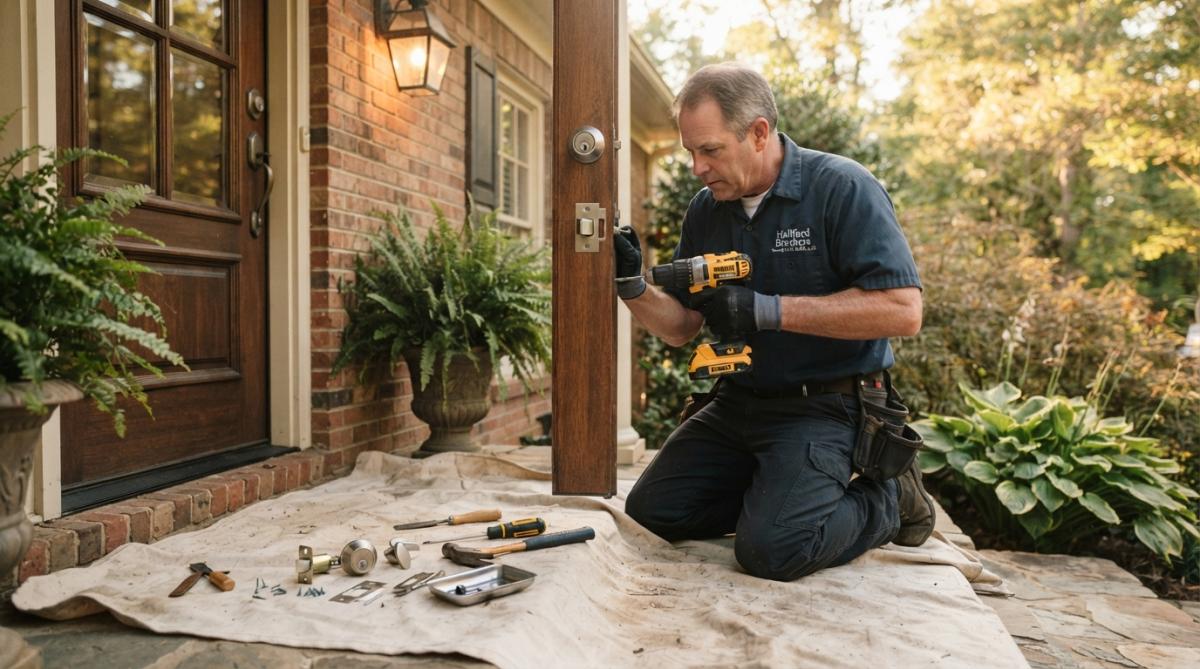
Here’s how the two halves typically break down:
| Cost Component | What It Covers | What Pushes It Higher |
|---|---|---|
| Hardware | Deadbolt, cylinder, strike plate, keys | Grade 1 rating, drill-resistant cylinder, premium finish |
| Door prep | Boring, chiseling, reinforcement | Steel or fiberglass door, non-standard thickness |
| Labor | Fitting and testing the lock | Mortise vs. cylindrical, second lock, master keying |
| Extras | Reinforcement plates, keyway upgrades | Bump-proof cylinder, restricted keyway |
The hardware is a one-time cost. The labor is where a cheap quote gets thin, because cutting corners on prep is invisible until the lock fails.
A deadbolt installed without a reinforced strike plate can be kicked open even when the lock itself is Grade 1 (pubmed.ncbi.nlm.nih.gov). The lock holds; the door frame gives way. Always confirm the quote includes strike plate reinforcement, not just the lock body.
Smart Lock Installation Cost vs. Mechanical Locks
Smart lock installation cost usually runs higher than a mechanical lock because you’re paying for electronics, an app, and often a compatibility check. A keyless entry or electronic deadbolt needs power, a wireless connection, and a door that can accept its specific backset and bore.
Mechanical locks win on simplicity and long-term reliability. Smart locks win on convenience and access control, but they add a category of cost mechanical locks never have: what happens when the electronics fail or the firmware stops getting updates.
Integration Risks and Long-Term Costs
The hidden cost of a smart lock is integration risk. A biometric lock or app-controlled deadbolt depends on a stable wireless network, a supported app, and a manufacturer that keeps patching security flaws (nist.gov). When a maker discontinues a model, its app can stop working, and your “smart” lock becomes a manual one.
Mechanical locks have no firmware, no app, and no update cycle. That’s the trade: you pay more upfront for smart features and accept ongoing risk, or you pay less for a mechanical lock and accept that you turn a key. For rental properties and commercial doors, many owners stick with high-security mechanical hardware for exactly this reason.
DIY vs. Professional Installation: Real Cost Comparison
DIY installation saves the labor line but introduces risk that can erase the savings. A cylindrical deadbolt into a pre-drilled wood door is a reasonable weekend job. A mortise lock, a steel door, or a master key system is not.
| Factor | DIY Installation | Professional Installation |
|---|---|---|
| Upfront cost | Hardware only | Hardware plus labor |
| Door prep risk | High on steel or fiberglass | Handled correctly the first time |
| Warranty | Void on most locks | Often covered by the installer |
| Time | A full afternoon or more | Single scheduled visit |
| Best for | Pre-drilled wood door, standard deadbolt | Mortise locks, steel doors, master keying |
The common mistake is buying a Grade 1 lock and installing it poorly. A misaligned bore or a shallow strike plate turns top-tier hardware into an easy target. If your door isn’t already drilled for the lock you bought, the savings from DIY usually evaporate.
Emergency Locksmith Service Fees and Maintenance Costs
Emergency service fees are the premium you pay for speed and after-hours availability, and they are the most variable line on any invoice. A lockout at midnight costs more than the same job at noon, and a commercial emergency during a holiday costs more still. But the bigger number most cost guides never add up is the five-year cost of ownership, what you actually spend on a high-security lock from installation to replacement, including the maintenance and emergency calls in between.
Budget for these separately from installation:
- Emergency call premium: After-hours, weekend, and holiday rates. The premium is usually a multiplier on the standard service call fee, not a flat add-on, so a higher base fee compounds the after-hours cost.
- Rekeying: Cheaper than replacement when the hardware is sound and you just want old keys dead.
- Cylinder replacement: Needed when a lock is worn or a key is lost. On a high-security cylinder with a restricted keyway, replacement often requires going back to the original manufacturer or dealer, which adds lead time and cost.
- Maintenance: Lubrication, tightening, and cylinder inspection keep locks working and catch wear early.
What Maintenance Actually Involves
High-security locks are not maintenance-free, and the maintenance they need is specific. A Grade 1 lockset with a drill-resistant cylinder and hardened steel inserts has more internal parts than a builder-grade deadbolt, and those parts wear against each other.
- Annual lubrication of the cylinder and bolt with a dry graphite or PTFE lubricant. Oil-based lubricants attract dust and gum up the pins, which is the opposite of what you want.
- Strike plate and frame inspection. The lock body may be fine while the frame around the strike plate has compressed or split.
- Cylinder pin inspection on restricted-keyway locks. Worn pins cause keys to stick or fail to throw the bolt fully, which is a security failure, not just an inconvenience.
- Electronic and smart lock firmware checks. If the lock has an app, the app needs updating, and the manufacturer needs to still support it. A discontinued model can lose remote access even though the physical lock still works.
The Five-Year Cost Picture
A mechanical high-security lock has a predictable cost curve: hardware and installation upfront, then a small annual maintenance cost, then replacement when the cylinder wears out or the keyway is compromised. A smart lock has the same curve plus a firmware and app-support risk that can force replacement earlier than the hardware wears out.
Rekeying is the cost-saver most people overlook. If you have just moved in and want the previous owner locked out, rekeying the existing cylinder costs far less than replacing every lock, provided the hardware is worth keeping. A master key system for a multi-unit property also pays off over time, since it cuts the number of keys you manage and the labor for future changes, but only if the system is designed correctly at installation.
Skipping maintenance does not save money, it moves the cost.
When you compare quotes, ask what the provider includes for the first year of maintenance and whether they stock replacement cylinders for the hardware they install. A provider who can service what they sold you is worth more over five years than one who cannot.
Frequently Asked Questions
What is the average cost to install a high-security door lock?
The total high security lock installation cost depends on the lock grade, your door’s condition, and labor rates. Hardware alone can range from basic to premium, while professional installation adds labor and potential door preparation fees. For an accurate quote specific to your door and security needs, visit Hallford Brothers Security Lock & Safe, LLC’s website to review current pricing.
Do smart locks void insurance?
Smart locks do not automatically void homeowners insurance, but coverage may be affected if the lock fails during a break-in or if installation does not meet policy requirements. Some insurers offer discounts for smart locks with verified security ratings. Check with your provider before installing, and ensure the lock meets ANSI grade standards for your door type.
Are high-security locks worth the extra installation cost?
High-security locks with ANSI Grade 1 or Grade 2 ratings offer better pick resistance, drill resistance, and bump proof features than standard locksets. For homes with valuable contents or businesses handling sensitive assets, the added protection often justifies the higher hardware and labor costs. A professional security assessment can help you decide which grade fits your risk level.
How does the cost of a smart lock compare to a traditional high-security lock?
Smart lock installation cost typically runs higher than mechanical high-security deadbolt installation because of the electronics, app integration, and occasional wiring needs. However, smart locks offer keyless entry, remote access, and audit trails that mechanical locks cannot. The right choice depends on whether you value convenience and monitoring over simplicity and lower upfront cost.