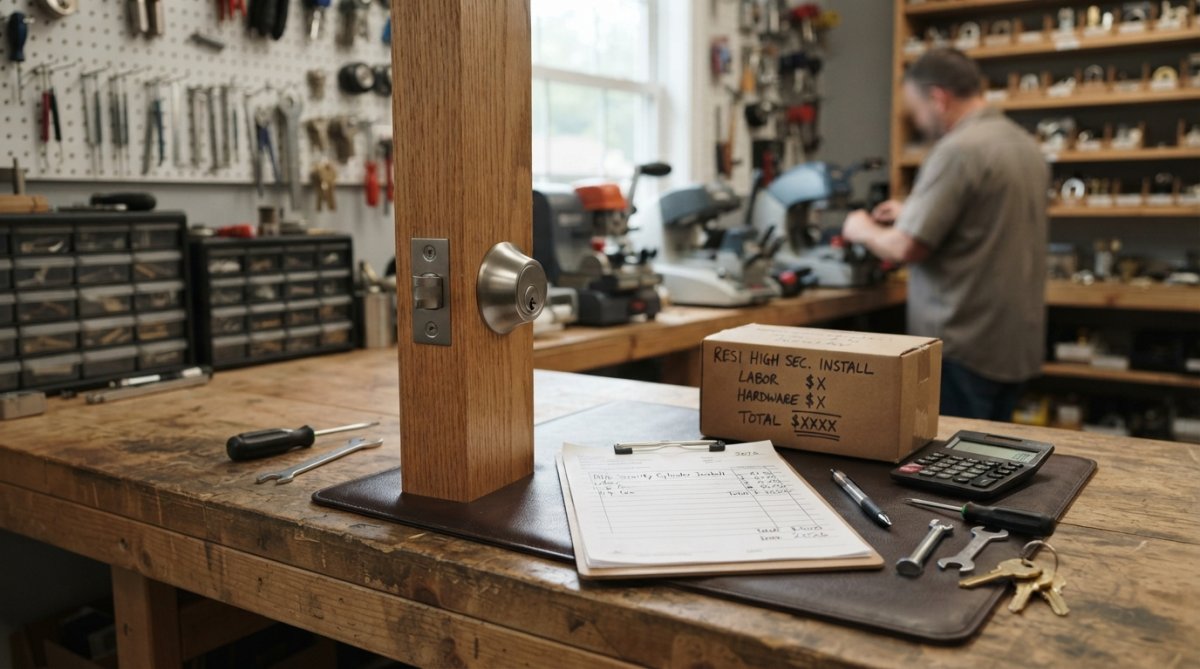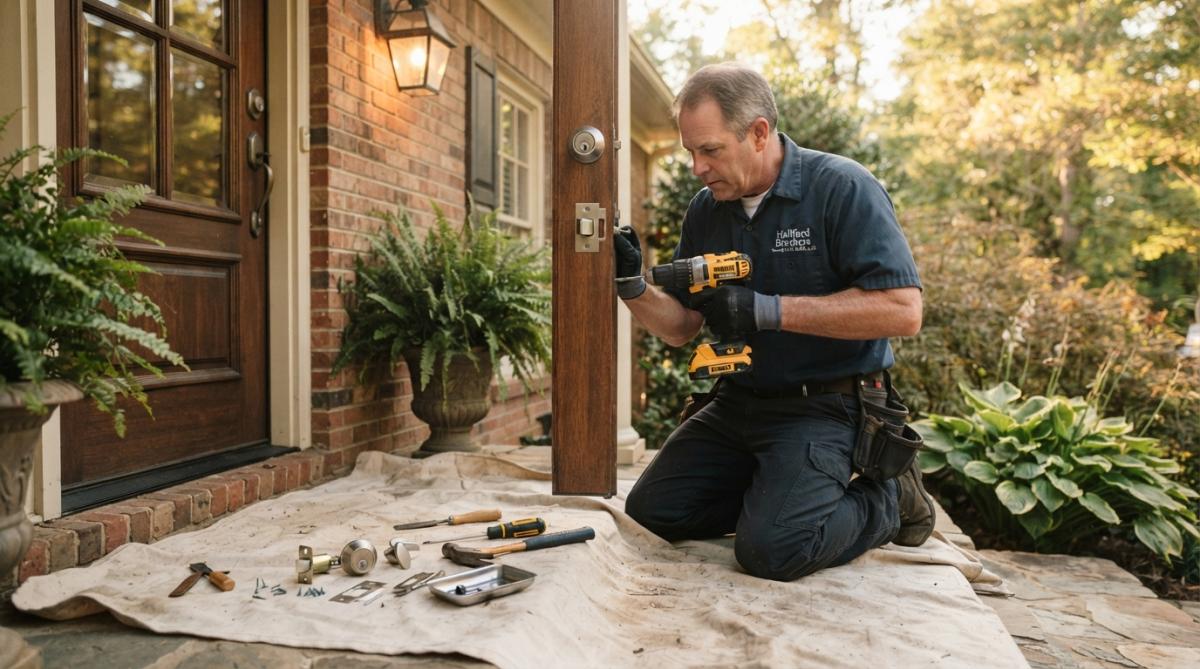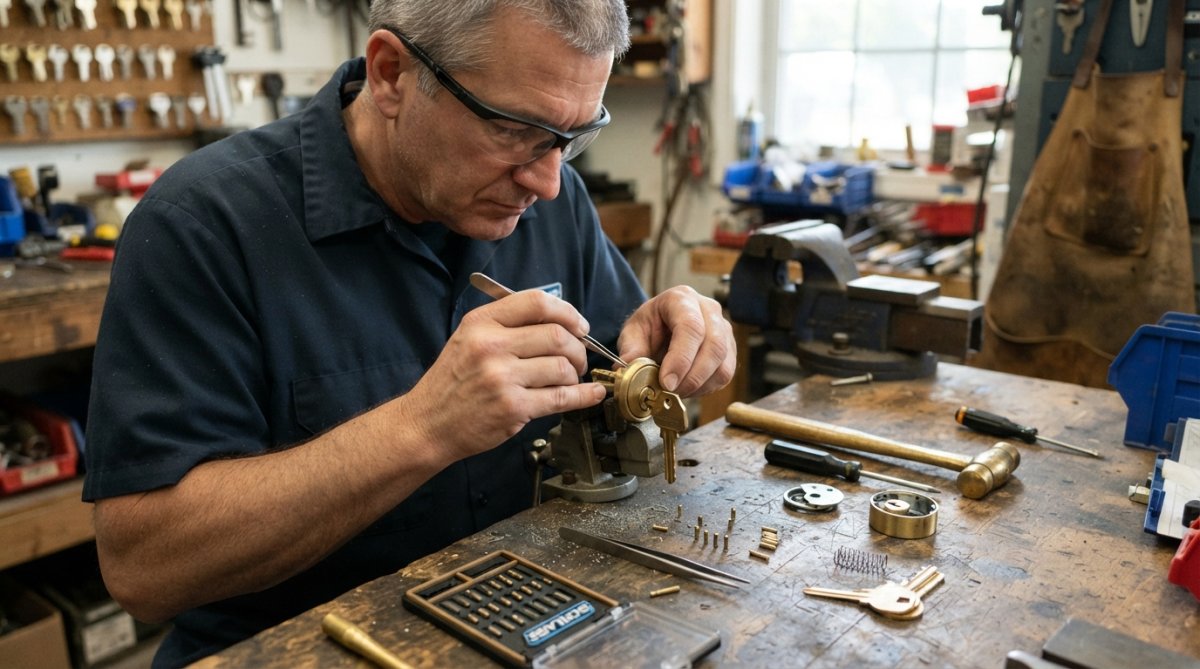
How to Rekey House Locks: Step-by-Step Guide

Posted on Categories BlogTags , , , ,

Learn how to rekey house locks with our step-by-step guide. Compare rekey vs replace locks cost and find the best lock rekeying kit. Get started.

Table of Contents

Last Updated: September 8, 2026

What Does It Mean to Rekey House Locks?

Rekeying a lock is the process of changing its internal mechanism so an old key no longer works, while a new key does. Rather than removing the entire lock, a technician or skilled homeowner replaces the tumbler pins inside the cylinder to match a different key bitting. This restores control over who can access your property, which matters most after moving into a new home or losing a key.

At Hallford Brothers Security Lock & Safe, LLC, we have spent over 56 years helping homeowners understand the difference between rekeying and full replacement. The core insight is simple: rekeying keeps your existing hardware while changing the lock cylinder’s internal pin stack. When the correct key is inserted, the pins align at the shear line, allowing the plug to rotate and retract the latch mechanism.

The primary reason to rekey house locks is security. You never know who still holds a copy of your current key, and guidance from the U.S. Department of Justice on residential security emphasizes controlling access as a fundamental layer of home protection.

Rekey vs Replace Locks Cost: Which Makes Sense?

The decision between rekeying and replacing is a security assessment, not just a price check. Rekeying is more economical when your hardware is in good working order and meets current standards. Replacing is better when the hardware is worn, damaged, or outdated, since a new deadbolt includes fresh components and often upgraded security pins.

Cost Breakdown: DIY vs. Professional

Here is a realistic look at what you’ll spend in the United States, based on current market rates:

Option DIY Cost Professional Cost Best For
Rekeying (per lock) $10-$20 for a pin kit (covers multiple locks) $50-$150 per lock, plus a $50-$100 service call fee Good hardware, lost key, new move-in
Replacing (per lock) $25-$60 for a new deadbolt (e.g., Kwikset or Schlage entry-level) $150-$300 per lock, including parts and labor Worn hardware, security upgrade

Key takeaway: For a typical 3-door home, a DIY rekey costs under $20 in materials, while a professional rekey runs $200-$550. Replacing three locks professionally can easily exceed $600. The cost gap narrows if you factor in the value of your time and the risk of a botched DIY job.

The Security Level Assessment

Before you decide, ask yourself: Is rekeying sufficient for my security needs? This is the question most generic guides ignore.

  • Rekey if: Your locks are ANSI Grade 2 or better, have no visible wear, and you simply need to invalidate old keys. This is the standard for most post-move-in scenarios.
  • Replace if: Your locks are ANSI Grade 3 (builder’s grade), show signs of corrosion, or lack a anti-pick shield. Grade 3 locks are common in new construction and are easier to bypass.
  • Upgrade if: You are in a high-crime area or want smart-home integration. A smart lock (e.g., Schlage Encode or Kwikset Halo) costs $150-$300 and eliminates physical keys entirely. This is not a rekey vs. replace question, it’s a different category of access control.

The Hidden Cost of Master Keying

If you are managing a rental property, the rekey-vs-replace math changes. A master key system requires precise pinning calculations and specialized key blanks. While a standard rekey is $10 in parts, a master keyed cylinder can cost $30-$50 per lock in parts alone, and the labor is not DIY-friendly. In this case, professional service is not a luxury, it is a necessity to avoid a system that fails to operate correctly.

Key Takeaway
Rekeying is the right choice for sound hardware. Replacing is right for worn hardware. Upgrading to smart locks is right when you need remote access or audit trails. Match the decision to your actual security posture, not just the upfront cost.

A common pattern among property managers is to rekey between tenants rather than replace every lock. This keeps the same heavy-duty hardware while ensuring the previous tenant’s key no longer functions. However, if you are upgrading for security reasons, replacing older locks with modern anti-pick models may be worth the additional expense.

Tools You Need: Finding the Best Lock Rekeying Kit

A quality lock rekeying kit contains the essential tools to disassemble your cylinder and swap the pin stack. At minimum, you need a follower tool to remove the plug without scattering springs, a plug removal tool for retaining clips, and tweezers to handle the small pins. Most kits also include key pins, driver pins, and a rekeying manual.

When shopping for a rekeying kit, verify that it matches your lock brand. A kit for a Schlage deadbolt will not necessarily fit a Kwikset doorknob assembly, as pin sizes and cylinder dimensions differ. Look for a kit that lists compatible brands and includes the correct follower tool diameter for your cylinder housing.

Watch Out
Do not attempt to rekey a lock with improvised tools like paperclips or screwdrivers. Without a proper follower tool, the springs inside the cylinder will eject, and you risk losing the tiny pins or damaging the plug beyond repair.

Step-by-Step: How to Rekey a Door Lock Cylinder

Rekeying a door lock cylinder rewards patience and careful organization. Before you begin, clear a workspace and lay out a magnetic tray to hold the pins and springs in order. You will need your rekeying kit, the new key, and a flat-head screwdriver.
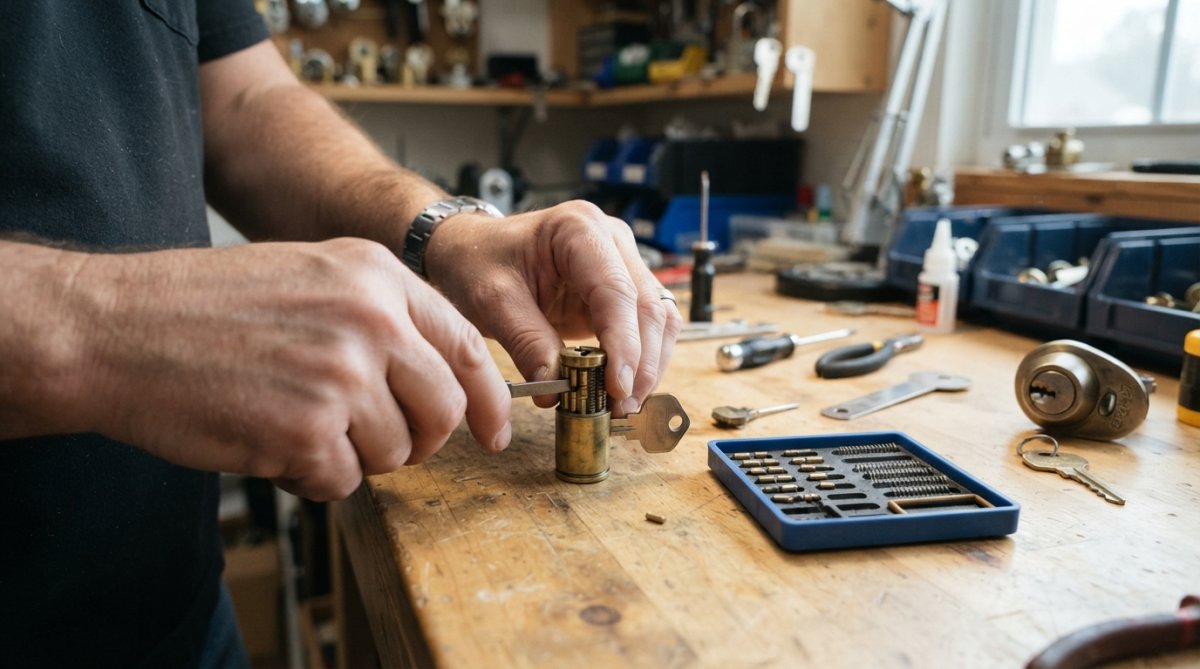
Close-up of a homeowner's hands using a metal follower tool to slide the plug out of a disassembled lock cylinder on a clean wooden workbench, with pins and springs arranged in a small magnetic parts tray under bright task lighting
Close-up of a homeowner’s hands using a metal follower tool to slide the plug out of a disassembled lock cylinder on a clean wooden workbench, with pins and springs arranged in a small magnetic parts tray under bright task lighting

Step 1: Remove the Lock Cylinder from the Door

Start by removing the screws on the interior mounting plate of the deadbolt or doorknob assembly. Pull the two halves of the lock apart, then disconnect the spindle and latch mechanism. With the interior hardware removed, slide the exterior cylinder out from the door. Set the screws aside in a labeled container so they do not get mixed up with the pins.

Step 2: Disassemble the Cylinder Housing

Insert your new key into the cylinder and turn it slightly to the locked position. Locate the retaining clip or cam at the rear of the plug and remove it with the plug removal tool. With the clip free, insert the follower tool into the cylinder housing to hold the driver pins and springs in place as you slide the plug out. Keep the follower tool pressed firmly against the plug to prevent springs from popping out.

Step 3: Replace the Tumbler Pins and Reassemble

Dump the old key pins from the plug into your tray. Referencing the bitting on your new key, select the correct key pins from your kit and drop them into each chamber of the plug. Slide the plug back into the housing while using the follower tool to transfer the driver pins and springs into place. Reinstall the retaining clip, test the new key, and then reattach the cylinder to your door.

How Long Does It Take to Rekey a Lock?

For a first-time DIYer, rekeying a single deadbolt typically takes 30 to 45 minutes once the lock is off the door (thisoldhouse.com). An experienced person can complete the pin swap in under 10 minutes per cylinder. The variable that slows most beginners is handling the tiny springs and pins without losing them.

If you are rekeying multiple locks, add roughly 10 minutes per additional cylinder after the first one. A house with three exterior doors might take about an hour of focused work, assuming you have the right kit and your locks are free of corrosion or damage.

Key Takeaway
Rekeying is a quick, cost-effective security measure. The primary time cost is your first attempt, so consider practicing on a spare interior door lock before working on your main entry points.

Brand Compatibility and Visual Troubleshooting

Lock manufacturers use different pin sizes, keyways, and cylinder dimensions, so brand compatibility is not optional. Here is the compatibility matrix most generic guides omit:

Brand-Specific Compatibility Matrix

Brand Keyway Pin Diameter Pin Sizes (Increments) Kit Compatibility
Kwikset KW1 (standard) / KW10 (smart key) 0.115 inches 0.018-0.045 inches (0.003 increments) Kwikset-specific kits only
Schlage SC1 (standard) / SC4 (restricted) 0.115 inches 0.018-0.045 inches (0.003 increments) Schlage-specific kits only
Baldwin Schlage-compatible (SC1) 0.115 inches Same as Schlage Schlage kits work
Weiser KW1 (many models) 0.115 inches Same as Kwikset Kwikset kits work
Yale Y1 (standard) 0.115 inches 0.018-0.045 inches (0.003 increments) Yale-specific kits only

Critical note: While Kwikset and Schlage share the same pin diameter, their keyways differ. A Schlage key will not insert into a Kwikset cylinder, and vice versa. Pin depths are also cut to different specifications, so you cannot swap pins between brands even if the diameter matches. Always verify the brand stamped on the plug or housing before purchasing a kit.

Visual Troubleshooting: What Went Wrong

When a lock does not reassemble smoothly, the problem is almost always one of four issues. Here is how to diagnose and fix each:

Symptom Likely Cause Visual Check Fix
Key will not insert fully A key pin is seated too high in the chamber, or a spring is binding Look into the plug chambers with a bright light. The pin should sit flush with the top of the chamber. Remove the pin, verify it matches the bitting depth, and reseat it.
Key inserts but will not turn The pin stack is too tall or too short for the shear line Insert the key and look at the gap between the plug and housing. You should see a clean break line at the shear line. Disassemble and re-measure each pin against the key bitting chart.
Plug will not slide out The retaining clip or cam was not fully removed Check the rear of the plug for a partially seated clip. Use the plug removal tool to fully disengage the clip before applying pressure.
Springs ejected during assembly The follower tool was not held firmly against the plug Look for springs and driver pins scattered in the housing. Retrieve all parts, re-lubricate the housing, and restart with the follower tool pressed firmly.

The “Dropped Pin” Scenario

A common mistake is dropping a key pin and not knowing which chamber it came from. If this happens, do not guess. Disassemble the plug completely, dump all remaining pins into a tray, and start fresh, matching each pin to the bitting chart for your new key. Guessing will result in a lock that jams or fails to operate on the correct key.

Watch Out
If your lock uses security pins (spool or mushroom-shaped drivers), visual troubleshooting is more complex (peer-reviewed research). Security pins are designed to catch on the shear line during picking attempts, which means they can also catch during assembly if not perfectly aligned. If you are working with security pins and the lock binds, disassemble and restart rather than forcing the key.

When Brand Compatibility Fails

If your lock is an off-brand or older model with a non-standard keyway, a standard rekeying kit will not work. You have two options: replace the cylinder with a standard brand-compatible one (cost: $15-$40) or call a professional locksmith who can order the correct pins. Do not file down pins or modify a key blank, this will damage the cylinder and void any warranty.

When to Call a Professional Locksmith

DIY rekeying works well for standard deadbolts, but several situations call for professional help. If you have a high-security lock with security pins or an anti-pick keyway, a mistake during assembly can render the cylinder useless. The same applies if your hardware is rusty, seized, or uses an uncommon keyway your kit does not support.

Property managers coordinating multiple units often benefit from a master key system, which requires precise pinning calculations far beyond a simple rekey. Professional locksmiths have the expertise and key blank inventory to match your existing hardware. At Hallford Brothers Security Lock & Safe, LLC, we handle everything from single-cylinder rekeys to complex master key systems, with upfront pricing before any work begins.

Conclusion: Secure Your Home with Confidence

Rekeying your house locks is one of the most direct ways to regain control over your home’s security, whether you just moved in or want peace of mind. The process is approachable for a careful DIYer, but it demands the right tools, brand-matched pins, and patience. When your locks are worn, you need a master key system, or you prefer a guaranteed result, a professional service removes the guesswork.

Trust the experienced team at Hallford Brothers Security Lock & Safe, LLC to handle your rekeying and lock upgrades with the reliability that comes from 56 years in the industry. Our specialists provide expert resolution of lock issues with upfront pricing, so you know the cost before we start. Get a quote today and secure your home with confidence.

Frequently Asked Questions

Is it cheaper to rekey or change locks?

Rekeying is almost always the cheaper option when the existing hardware is in good condition. A rekeying kit costs far less than a full set of new locks, and if you do it yourself, you save on labor. Replacing locks makes sense only when the hardware is worn, damaged, or you want an upgrade, since new locks cost more per unit and require additional installation time.

Can you rekey a lock without replacing the lock?

Yes, that is the entire purpose of rekeying. The process involves removing the cylinder, swapping out the tumbler pins to match a new key, and reassembling the lock. The external hardware stays in place, so the lock looks and functions the same, but the old key will no longer work. This is a common practice after moving into a new home.

How long does it take to rekey a lock?

A single standard doorknob or deadbolt lock takes about 15 to 30 minutes for a first-timer using a rekeying kit. Once you have done a few, you can finish one in under 10 minutes. That time can increase if you encounter stripped screws, a stuck retaining clip, or an unfamiliar brand with a different cylinder design.

What tools are required to rekey a residential lock?

The best lock rekeying kit includes a follower tool, a plug depressor, and a set of new pins matched to your key bitting. You will also need a screwdriver to remove the lock from the door, needle-nose pliers for extracting old pins, and a small tray to keep springs and pins organized. Most kits are brand-specific, so verify compatibility before purchasing.


This guide provides general information on rekeying standard residential locks. For specific hardware or complex security needs, consult a licensed professional locksmith.
Locksmith Damage Liability Explained: Who Pays in 2026?

Posted on Categories BlogTags , , , ,

Locksmith damage liability explained: learn who pays for scratched doors, broken locks, and failed re-keys, plus how to file a claim and protect your home.

Table of Contents

Last Updated: September 13, 2026

What Locksmith Damage Liability Actually Covers

Locksmith damage liability is the legal and financial responsibility a locksmith bears when their work damages a customer’s property. This guide breaks down who pays when a lock, door, or frame gets damaged during a service call. Most disputes come down to one question: was the damage an honest accident or careless workmanship?

Liability generally covers three things: the lock hardware, the surrounding door and frame, and any personal property damaged in the process. A technician who scratches a deadbolt while re-keying it is in a very different situation than one who cracks a door panel with a pry bar.

Accidental Damage vs. Negligent Workmanship

The line between accidental damage and negligence is where most claims are won or lost. Accidental damage is unintended harm despite reasonable care, such as a drill bit slipping on an older, brittle lock cylinder. Negligent workmanship is harm caused by failing to meet a reasonable standard of care, such as using the wrong tool.

A common mistake is assuming any damage equals liability. A technician who follows proper procedure and still damages a 40-year-old lock is usually not held responsible, because the hardware failed on its own. One who skips basic steps, like checking for a secondary lock before prying, is far more likely to be found negligent.

Locksmith Insurance Requirements: What Every Pro Should Carry

Locksmith insurance requirements vary by state, but most reputable operations carry a core set of policies regardless of what the law mandates. A general liability insurance policy is the foundation, covering third-party claims for property damage and bodily injury during a job. Without it, a single damaged door could come straight out of the technician’s pocket.

General Liability, E&O, and Commercial Auto

Three policy types do most of the work in this industry:

  • General liability insurance: Covers property damage and bodily injury to third parties, such as a customer’s door or a passerby injured on the job site.
  • Errors and omissions (E&O): Covers professional negligence claims, like a botched master key system that leaves a building insecure.
  • Commercial auto: Covers vehicles used for service calls, including the mobile key-cutting setups many technicians run.

A business owner policy often bundles general liability with property coverage, which is a practical option for a small shop. The U.S. Small Business Administration guidance on business insurance explains how these policies fit together for service businesses.

What Drives the Cost of a Locksmith Policy

Premiums are not one-size-fits-all. Main cost factors:

  • Annual revenue: Higher revenue means higher exposure, so insurers scale premiums accordingly.
  • Number of employees and subcontractors: Each additional tech adds payroll and risk to the policy.
  • Service mix: Mobile-only lockout work prices differently than commercial master key installation or safe servicing.
  • Claims history: A prior property damage or E&O claim will follow the business for years.
  • Coverage limits: A $1 million per-occurrence general liability limit costs more than a $500,000 limit, but many commercial clients require the higher number contractually.
  • State and territory: Rates vary by region based on litigation climate and repair costs.

Most small locksmith operations pay a few thousand dollars a year for a bundled general liability and E&O policy, while larger commercial-focused shops pay more. Compare quotes line by line, not on the total alone.

Common Exclusions to Read Before Signing

Every liability policy has exclusions, and the ones that bite locksmiths most often are:

  • Intentional acts: Damage a technician causes on purpose is never covered.
  • Faulty workmanship: The cost of redoing the locksmith’s own defective work is typically excluded, even when the resulting property damage is covered.
  • Wear and tear: Pre-existing deterioration of a lock or frame is not a covered loss.
  • Vehicle use off the job: Personal errands in a company van may fall outside commercial auto coverage.
  • Cyber and data: Customer key codes and access records stored digitally usually need a separate cyber endorsement.

Endorsements Worth Adding

  • Lost key coverage: Responds when a customer’s keys are lost or stolen and re-keying is required.
  • Tools and equipment floater: Covers the pick sets, key machines, and diagnostic gear that travel between jobs.
  • Care, custody, and control: Fills the gap when a customer’s lock or safe is in the technician’s possession and is damaged.
Pro Tip
Ask any locksmith for a certificate of insurance before they start work. A legitimate operation will provide it without hesitation. If a technician can’t produce one, that’s your signal to call someone else, because you may have no recourse if your property is damaged.

A liability policy does more than pay for a damaged door. It also funds legal defense costs if a customer sues, which can dwarf the repair bill. Defense costs are usually paid outside the policy limit on general liability policies, leaving the full limit available for a settlement or judgment. On some E&O policies, defense costs are paid inside the limit, eroding the amount available to settle. Reading that distinction before a claim happens is one of the most practical things a locksmith can do.

How to File a Claim Against a Locksmith: A Step-by-Step Process

Filing a claim against a locksmith follows a predictable path, and documenting each step is what makes it succeed:

  1. Document the damage immediately. Photograph the damaged property from multiple angles before anything is moved or repaired.
  2. Notify the locksmith in writing. Send a dated message describing the damage and requesting a response. Keep a copy.
  3. Request the certificate of insurance. Ask for the insurer’s name and policy number so you can file directly if needed.
  4. Get a repair estimate. A written estimate from a third party establishes the dollar value of your claim.
  5. File with the locksmith’s insurer. If the business won’t resolve it directly, file a third-party claim against their liability policy.
  6. Escalate if necessary. Small claims court handles most residential disputes, and consumer protection agencies can step in for unresolved cases.

The FTC consumer complaint process is a useful resource if a business refuses to engage. For larger commercial losses, the Better Business Bureau dispute resolution guidance offers a mediation path before legal action.

Step Action Who Handles It Typical Timing
1 Photograph damage Customer Same day
2 Written notice Customer Within 24-48 hours
3 Request insurance info Customer Within 1 week
4 Get repair estimate Third-party contractor Within 1 week
5 File third-party claim Insurer Within policy window
6 Escalate if unresolved Court or agency After 30 days

Preventing Property Damage During Lockouts: What Customers and Techs Can Do

Preventing property damage during lockouts comes down to preparation on both sides of the door. Most damage happens because of rushed decisions, not bad intentions. A homeowner who calls the first number they find and a technician who arrives without the right tools are a recipe for a cracked frame.

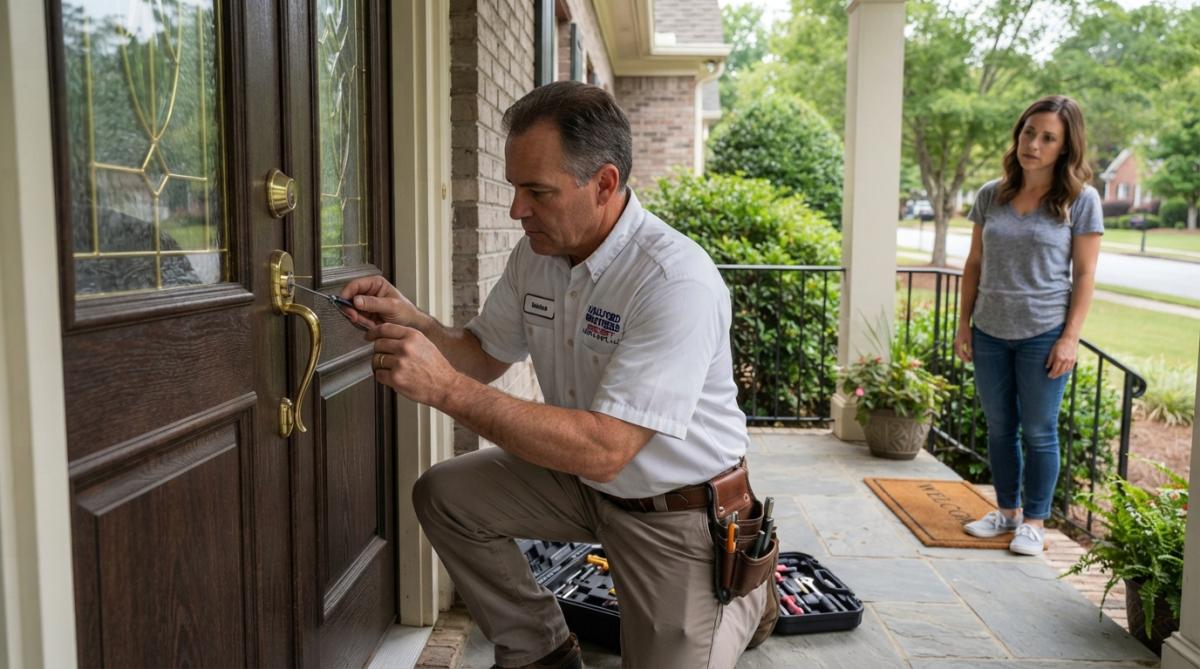
A professional locksmith in work clothes kneeling at a residential front door, using a pick tool on the lock cylinder while a homeowner watches from a few feet away on a suburban porch in daylight

For customers, verify credentials before anyone touches the lock: confirm a physical address, ask about insurance, and get a price before work begins. For technicians, risk mitigation starts with a proper assessment: identify the lock type, check for secondary locks, and choose non-destructive entry whenever possible. Re-keying rather than drilling preserves the hardware and avoids the most common damage claims.

Get Quote →

Watch Out
The most expensive mistake during a lockout is letting an unverified technician drill the lock immediately. Drilling destroys the cylinder and often the surrounding hardware, turning a simple entry into a full lock replacement. Always ask for a non-destructive attempt first.

Does Homeowners Insurance Cover Locksmith Damage?

Homeowners insurance sometimes covers locksmith damage, but it depends on who caused it. If a locksmith damages your door while working, the claim generally goes against the locksmith’s liability policy first, not your own. Your household contents insurance and dwelling coverage typically respond to theft or vandalism, not damage caused by a contractor you hired.

If a burglar damages your door during a break-in, your homeowners policy usually covers the repair. If your own locksmith cracks the frame during a legitimate service call, that’s a third-party claim against the technician’s insurance. That distinction trips up a lot of homeowners.

When Your Own Policy Might Respond

There are narrow situations where your homeowners policy can step in for locksmith-related damage:

  • Vandalism after a break-in: If the door was damaged by the intruder, not the locksmith, dwelling coverage typically applies.
  • Damage during a covered loss: If a fire or storm forces an emergency lockout and the technician damages the frame during entry, the loss may fold into the larger claim.
  • Uninsured contractor: If the locksmith has no liability coverage and refuses to pay, some homeowners policies will cover the damage and then pursue the locksmith through subrogation, the insurer’s right to recover from the at-fault party.

The Subrogation Angle Most Homeowners Miss

When your insurer pays a claim caused by someone else, it steps into your shoes and sues the responsible party to recover what it paid. Filing with your own insurer can therefore trigger a recovery action against the locksmith. For the homeowner, this is often the fastest path to a repair, but a claim on your record, even one that gets subrogated, can affect future premiums.

Your Deductible and the Math of a Small Claim

Your deductible also matters. Filing a small claim against your own policy can raise your premium more than the repair is worth, so for minor damage it often makes more sense to pursue the locksmith directly. A homeowner weighing a $500 deductible against a $400 repair estimate realizes the insurance route costs more than it recovers. In that scenario, a written demand to the locksmith, backed by photos and a repair estimate, is usually the better first move.

Consumer-Side Claims Process: What Most Guides Skip

Nearly every article on this topic is written for locksmiths buying insurance. Very few explain what a homeowner should do when a locksmith damages their property. The short version:

  1. Photograph everything before the technician leaves the property.
  2. Get the business name, license number, and certificate of insurance in writing.
  3. Send a dated written demand describing the damage and the amount you’re seeking.
  4. File a third-party claim with the locksmith’s general liability insurer if the business won’t resolve it directly.
  5. Notify your own insurer only if the locksmith is uninsured or the damage is large enough to justify a claim on your record.
  6. Escalate to small claims court for disputes under your state’s monetary limit, which is commonly a few thousand dollars for residential property damage.
Watch Out
Do not let the locksmith repair the damage themselves before you have documented it. Once the evidence is gone, proving the extent of the loss becomes far harder, and the locksmith’s insurer may dispute the claim.

What Homeowners Insurance Will Not Cover

  • Faulty workmanship by the locksmith: Your policy is not a warranty on someone else’s labor.
  • Damage the locksmith caused through negligence: That is a third-party liability claim, not a first-party one.
  • Pre-existing wear: A frame that was already rotting before the service call is not a covered loss.
  • Cosmetic scratches: Most policies have a threshold below which a claim is not worth filing.

The practical takeaway: your homeowners policy is a backstop, not the primary route. The locksmith’s liability coverage is the first place to look, and knowing that distinction separates a resolved claim from a stalled one.

Liability Waivers, Service Agreements, and What They Really Mean

Liability waivers and service agreements set the rules before any work begins, and most customers sign them without reading. A service agreement outlines the scope of work, the price, and the limits of the technician’s responsibility. A damage waiver may shift certain risks back to the customer, but it cannot waive liability for negligence in most cases.

This is the part most guides get wrong. A waiver does not give a locksmith a free pass to damage your property carelessly. Courts generally refuse to enforce waivers that shield a business from its own professional negligence. What a waiver can do is clarify that the customer accepts the risk of pre-existing weaknesses, like a door frame that was already rotting.

For property managers handling multiple units, a clear service agreement with defined policy limits and indemnity terms prevents disputes before they start. Hallford Brothers Security Lock & Safe, LLC works with property managers in Marietta and Smyrna to set up master key systems and service agreements that spell out exactly who is responsible for what.


Locksmith damage liability comes down to preparation, documentation, and choosing a technician who stands behind their work. Hallford Brothers Security Lock & Safe, LLC brings over 56 years of experience to every job, with upfront pricing, a storefront you can visit, and a team that treats your property like their own. Whether you need an emergency lockout resolved or a master key system designed for multiple properties, you can get a quote and talk through your options with an experienced specialist. Get started with Hallford Brothers Security Lock & Safe, LLC and protect your property with confidence.

Frequently Asked Questions

Are locksmiths responsible for damage caused during a lockout?

In most cases, yes. If a locksmith scratches a door, breaks a cylinder, or damages a frame while working, that falls under locksmith damage liability and the company’s general liability insurance typically covers the repair. The exception is damage the customer authorized in writing, such as drilling a lock when no other entry method works. Always ask for a written service agreement before work starts and photograph any pre-existing damage.

How do I prove a locksmith caused damage to my property?

Document everything before and after the visit. Take timestamped photos of the door, frame, and lock before the tech starts, keep the invoice and any signed work authorization, and note the technician’s name and license number. If damage appears after the job, get a written repair estimate from a separate contractor. Most insurers and small claims courts accept this combination of photos, receipts, and a third-party estimate as proof.

What should I look for in a professional locksmith’s insurance policy?

Ask for a certificate of insurance showing general liability coverage, and confirm the policy is active by calling the listed insurer. A serious locksmith business should also carry errors and omissions coverage for faulty workmanship, plus commercial auto for mobile service. If a company cannot produce a COI on request or hesitates, treat that as a red flag and hire someone who can.

Does homeowners insurance cover damage caused by a locksmith?

It depends on the cause. If a locksmith damaged your door while you hired them, your homeowners policy may cover the repair under the liability portion, and your insurer can pursue the locksmith’s insurance for reimbursement. Damage that happened during a burglary, rather than a service call, is usually handled under your dwelling or personal property coverage. Report the incident promptly and keep all documentation.

Best Commercial Security Systems 2026: Buyer’s Guide

Posted on Categories BlogTags , , , ,

Compare the best commercial security systems for 2026. Learn about access control, monitoring options, and installation costs. Get a quote today.

Table of Contents

Last Updated: September 11, 2026

How to Compare Commercial Security Systems in 2026

Choosing among the best commercial security systems 2026 has to offer starts with one hard truth: the consumer-grade kits sold at warehouse stores were never built for a business with employees, inventory, and liability. This buyer’s guide from Hallford Brothers Security Lock & Safe, LLC walks through the evaluation criteria that actually matter, from monitoring models to access control, so you can spec a system that holds up under real commercial use.

A commercial security system is an integrated set of hardware and software, including cameras, access control, intrusion detection, and monitoring, designed to protect a business property and the people and assets inside it. Unlike a residential setup, a commercial-grade system must handle multiple entry points, user permissions, audit logs, and often compliance requirements.

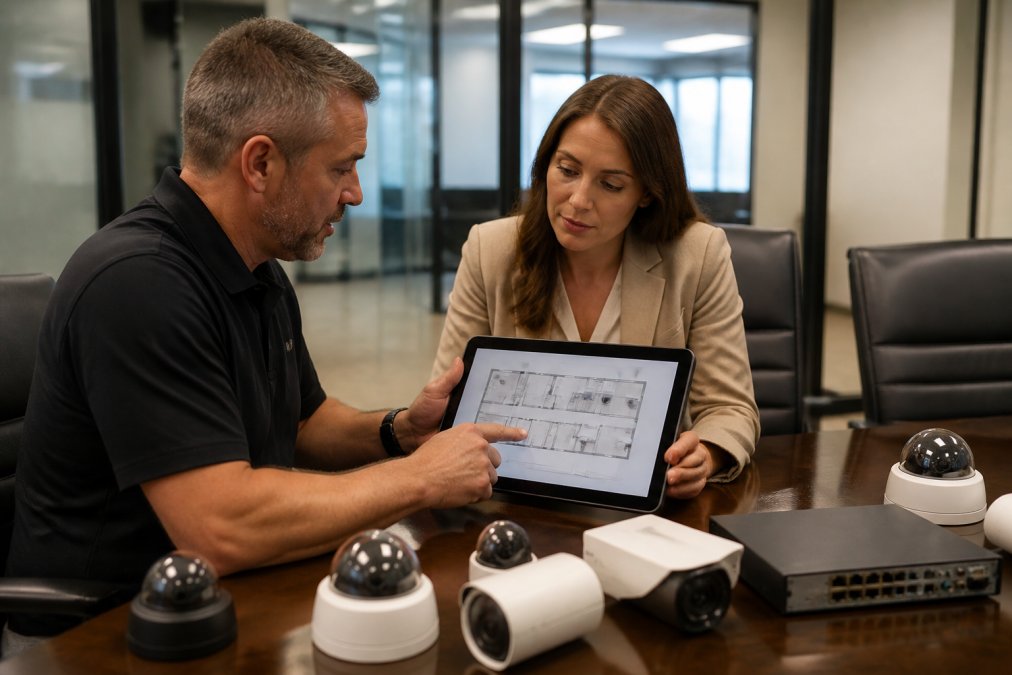
A security consultant and a business owner reviewing a tablet with a building floor plan and camera placement markers in a modern office conference room

The evaluation criteria that separate serious systems from toys:

  • Scalability: can the platform add doors, cameras, and sites without a rip-and-replace?
  • Integration: does it talk to existing access control, fire and life safety, and legacy hardware?
  • Monitoring model: professional monitoring versus self-monitoring, and what each costs you in response time
  • Total cost of ownership: upfront hardware versus recurring subscription tiers
  • Compliance fit: does it satisfy the requirements specific to your industry?

Most buyers fixate on camera resolution and miss the two factors that drive long-term cost: integration with what you already own and the recurring subscription structure. Get those wrong and a “cheap” system becomes expensive fast.

Professional Monitoring vs. Self-Monitoring for Business Security

Professional monitoring means a trained team watches your alarms and video around the clock and can trigger automated dispatch when something trips. Self-monitoring puts that responsibility on you or your staff through a mobile app.

The trade-off is cost versus response. Professional monitoring carries a monthly fee, but it delivers real-time alerts to a monitoring center that can contact police or fire services immediately. Self-monitoring is cheaper upfront, but if no one is watching the app at 2 a.m., a break-in goes unanswered. For most businesses with physical assets on site, professional monitoring is the safer default. Self-monitoring fits low-risk locations or businesses with staff present around the clock.

Pro Tip
Ask any provider for their service level agreement in writing before you sign. A strong SLA spells out response times, uptime guarantees, and what happens when the system goes down. If they won’t put it in writing, walk away.

Commercial Access Control Systems: Keypads, Fobs, and Biometric Authentication

Commercial access control systems determine who gets in, where, and when. The three common authentication methods each fit different needs:

  • Keypads: lowest cost, easy to retrofit, but codes get shared and rarely changed
  • Fobs and cards: fast, durable, and easy to revoke when an employee leaves
  • Biometric authentication: fingerprints or facial recognition, hardest to spoof, best for high-security areas

The real value of a modern access control system is the audit log. Every entry is timestamped and tied to a user, which matters enormously if you ever need to investigate an incident or prove compliance. Look for systems with granular user permissions and remote arming so you can lock down a door from your phone.

Business Security Camera Installation Cost: What Drives the Price

Business security camera installation cost depends on camera count, resolution, wiring runs, storage model, and whether the property needs access control tied into the same platform. There is no single number, because a two-camera retail front and a 40-camera warehouse with gate control are different projects entirely. What follows is the cost architecture most integrators use to quote commercial work, plus the recurring costs buyers routinely forget to model.

The five cost drivers that actually move a quote

Cost Driver What It Affects Lower-Cost Option Higher-Cost Option
Camera count Total hardware and labor 2-4 cameras 20+ cameras across multiple structures
Cabling Labor and materials Wireless bridge where signal allows Hardwired Cat6 or fiber runs, conduit, trenching
Storage Recurring cost On-premises NVR with local drives Cloud or hybrid subscription per camera
Resolution and analytics Image detail and searchability 1080p fixed 4K with person/vehicle detection and license plate capture
Integration Platform and licensing Standalone camera system Unified access control, intrusion, and video on one dashboard

Two structural choices dominate the total: wired versus wireless, and local versus cloud storage. Hardwired runs cost more in labor and materials but deliver more reliable uptime and are generally required where conduit and code compliance matter. Cloud storage adds a per-camera recurring fee but gives you redundancy and remote access without maintaining a recorder on site.

Build a three-year total cost of ownership model, not a sticker-price comparison

Most buyers compare upfront hardware quotes and stop there. The number that matters is total cost of ownership (TCO) across the life of the system. A practical model has five lines:

  1. Hardware, cameras, recorders, readers, panels, locks, and mounting hardware.
  2. Installation, labor, cabling, conduit, and any electrical work.
  3. Recurring subscriptions, monitoring, cloud storage, cellular backup, and software licensing, multiplied by 36 months.
  4. Maintenance, cleaning, firmware updates, drive replacement, and service calls.
  5. Expansion, doors, cameras, or sites you expect to add within the window.

A system with a low hardware price and a high per-camera cloud tier often costs more over three years than a commercial-grade platform with a higher upfront cost and predictable fees. Run the math both ways before you sign.

The costs competitors leave out

  • False alarm dispatch fees. Many jurisdictions charge a fee after a set number of false alarms in a rolling period, and some suspend police response to chronic offenders. Video verification, where a monitoring center confirms a human or vehicle before dispatch, is the single most effective way to cut nuisance alarms and the fees that follow. Ask any provider whether their monitoring center offers video verification and how it is priced.
  • Compliance-driven hardware. If your industry falls under a regulatory framework, healthcare privacy rules, payment card standards, or insurance-mandated security requirements, your camera placement, retention period, and access logging may be prescribed rather than optional (hhs.gov). Compliance requirements can add cameras, storage capacity, and audit-logging features that a generic quote will miss.
  • Legacy hardware bridging. If you already own functional analog cameras or older readers, an integrator can often bring them onto a new platform through encoders or gateway devices rather than forcing a full replacement. This is frequently the largest single line-item saving available to an existing business.

For pricing tailored to your property, request a written quote that itemizes hardware, installation, and recurring fees separately, so you can compare TCO rather than sticker price.

Get Quote →

Pro Tip
Ask for the quote broken into one-time and recurring lines. A provider who will not separate them is hiding the subscription structure, which is where the long-term cost lives.

Commercial Locksmith Services for Businesses: Beyond Lock Repair

Commercial locksmith services for businesses cover far more than fixing a jammed lock. A full-service provider handles master key systems, rekeying after tenant turnover, safe servicing, and the physical hardware that anchors your access control.

A master key system is a hierarchical keying setup where one master key opens every lock in a building while individual keys open only specific doors (aloa.org). For property managers overseeing multiple units, this is the difference between carrying a ring of 30 keys and carrying one.

What most businesses miss: your electronic access control still depends on mechanical locks and cylinders that wear out. A card reader on a failing door closer is a security gap. Pair your digital system with regular hardware servicing, and rekey every lock when a tenant or employee with access leaves. Hallford Brothers Security Lock & Safe, LLC has handled master key systems and commercial hardware for businesses across the NW Metro Atlanta area for decades, with upfront pricing before any work begins.

Watch Out
The biggest mistake businesses make is rekeying only the front door when a key-holding employee leaves. Every lock that person’s key could open is now a liability. Rekey the full set, not just the main entrance.

Scalability, Integration, and Total Cost of Ownership

Scalability and integration decide whether your system survives your next growth spurt. A platform that cannot add doors, cameras, or a second location without a full replacement will cost you far more in three years than one that scales cleanly. The way to tell the difference before you buy is to ask three questions: How does the platform add a door or camera, license, hardware, or both? Does it support multiple sites on one dashboard? And can it ingest hardware you already own?

What scalable actually means in practice

Scalability is not a marketing word; it is a set of concrete capabilities:

  • Additive licensing. Adding a camera or door should mean buying a license or a device, not replacing the head-end. Ask whether user seats, sites, and devices are licensed separately or bundled.
  • Multi-site architecture. For businesses with more than one location, confirm the platform supports a centralized dashboard, consistent user permissions across sites, and unified audit logs. A system that requires a separate login per site does not scale.
  • Open standards. Look for platforms that support common integration standards so cameras, readers, and panels from different manufacturers can coexist. Proprietary-only ecosystems lock you into one vendor’s pricing.
  • API and integration surface. If you plan to tie security into scheduling, HR, or building management systems, confirm the platform exposes an API or documented integrations.

Bridging legacy hardware instead of ripping it out

Many businesses already own functional analog cameras, older card readers, or a working intrusion panel. A good integrator can often bring that hardware onto a modern platform rather than forcing a full replacement. Common mechanisms include video encoders that convert analog camera feeds to a networked platform, gateway devices that translate older reader protocols, and middleware that unifies disparate systems under one interface. This is frequently the largest single saving available to an existing business, and it is the step most generic buying guides skip entirely.

Total cost of ownership over a five-year horizon

Build the model before you buy. Add up hardware, installation, monthly monitoring, cloud storage, software licensing, and maintenance over a five-year horizon, then add expected expansion. A system with a low sticker price and high subscription tiers often costs more than a commercial-grade platform with a higher upfront cost and predictable fees. The line items that separate a cheap system from an economical one are almost always recurring: per-camera cloud storage, per-door licensing, and monitoring tiers.

Two angles most buyers overlook

  • Compliance fit. If your industry is subject to regulatory or insurance-mandated security requirements, your platform must produce the audit logs, retention periods, and access records those frameworks require. A system that cannot export an audit trail is a compliance liability, not just a security one. Confirm retention and export capabilities in writing before purchase.
  • False alarm mitigation. Repeated false alarms erode police response and can trigger fines in many jurisdictions (cisa.gov). Video verification and properly tuned motion sensors cut nuisance alerts dramatically. Ask your provider how their monitoring center handles verification and whether it is included or an add-on.

For multi-site management, confirm the platform supports centralized dashboards, consistent user permissions, and unified audit logs across every location, and test the dashboard with a second site before you commit to a rollout.

Key Takeaway
Scalability, integration, and TCO are the same conversation. A platform that scales cleanly, ingests your existing hardware, and produces compliance-ready audit logs will almost always win on five-year cost, even when its upfront quote is higher.

Conclusion

The hardest part of buying a commercial security system isn’t picking cameras. It’s matching the system to how your business actually operates, then keeping the mechanical and digital sides maintained together. Hallford Brothers Security Lock & Safe, LLC brings 56 years of experience, a storefront you can walk into for straight answers, and upfront pricing on everything from master key systems to camera installation and safe servicing. Get a quote from Hallford Brothers Security Lock & Safe, LLC and build a security setup that scales with your business.

Frequently Asked Questions

What features should I look for in commercial security systems in 2026?

Prioritize professional monitoring, cloud-based surveillance, and access control systems that support biometric authentication or mobile management. Look for real-time alerts, end-to-end encryption, and audit logs for user permissions. Scalability matters if you plan to add locations. Check whether the system supports integration with existing smart building infrastructure or legacy hardware. A service level agreement with defined system uptime guarantees is also worth requiring before you sign.

How much do professional commercial security system installations cost?

Business security camera installation cost depends on camera count, resolution, wiring requirements, and whether you need access control integration. Hardwired systems typically cost more upfront than wireless but offer more reliability. Monthly subscription tiers for cloud storage and professional monitoring add recurring costs. Hallford Brothers Security Lock & Safe, LLC provides upfront pricing and can assess your site to give an accurate quote based on your specific layout and needs.

What is the difference between DIY and professional commercial security monitoring?

DIY systems rely on self-monitoring through a mobile app, which means you handle real-time alerts and automated dispatch yourself. Professional monitoring routes alerts to a staffed center that can verify the threat and contact law enforcement, reducing false alarm risk. For businesses with multiple sites or compliance requirements, professional monitoring with a defined service level agreement is usually the better fit. Self-monitoring can work for low-risk locations where someone is always on site.

How do I integrate access control with commercial alarm systems?

Integration starts with choosing access control systems that communicate with your alarm panel, often through a shared software platform or API. Motion sensors, door contacts, and intrusion detection can trigger camera recording or lock down specific areas automatically. For multi-site management, cloud-based platforms let you set user permissions and review audit logs from one dashboard. A commercial locksmith can assess whether your existing hardware supports integration or needs replacement.

Cost to Replace Transponder Key: 2026 Pricing Guide

Posted on Categories BlogTags , , , ,

What does it cost to replace transponder key in 2026? Compare dealership vs. locksmith pricing, programming costs, and options when you have no spare.

Table of Contents

Last Updated: September 9, 2026

What Is a Transponder Key and Why Is It Expensive?

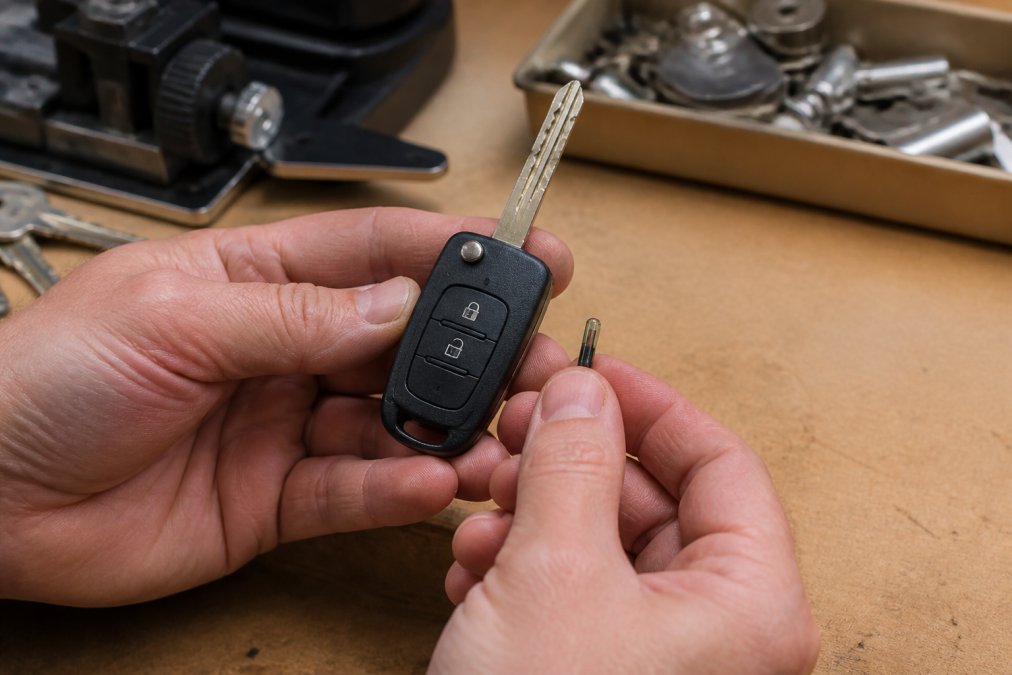
A transponder key is a car key embedded with a microchip that communicates with your vehicle’s immobilizer system before the engine will start. Unlike a standard metal key, it transmits a unique radio frequency code that must match your car’s security protocol, which is why a basic key blank won’t work. At Hallford Brothers Security Lock & Safe, LLC, we’ve spent over 56 years helping drivers understand that this anti-theft technology is precisely what drives up the cost to replace transponder key scenarios.

The chip inside the key head contains no battery; it draws power from the radio frequency signal sent by your ignition system (nhtsa.gov). When you insert the key, the immobilizer chip and your car’s computer exchange a security code. If they don’t match, the engine stays locked. That authentication process requires specialized equipment to replicate, which is the core reason replacement isn’t as simple as cutting a new blade.

Close-up of a locksmith's hands holding a modern car key with a small transponder chip visible next to the key blade on a well-lit workbench
Close-up of a locksmith’s hands holding a modern car key with a small transponder chip visible next to the key blade on a well-lit workbench

Average Cost to Replace Transponder Key by Type

The cost to replace transponder key types varies significantly based on the technology inside the key head. Standard chip keys fall at the lower end of the spectrum, while smart keys and proximity keys with keyless entry and push-button start sit at the top because they contain more complex circuitry.

  • Standard chip key: Most affordable option; requires programming to match your immobilizer system
  • Remote head key: Combines the transponder chip with lock and trunk buttons
  • Smart key / proximity key: Allows keyless entry and push-button ignition; most expensive to replace

Your vehicle’s make and model also dictates the price. Luxury brands often use proprietary security protocols that demand specific diagnostic tools. The key blade itself may require VIN-based key cutting, where the locksmith uses your vehicle identification number to mill the correct mechanical cuts, adding another layer of precision and cost.

Watch Out
Do not buy a cheap blank key online before confirming it matches your vehicle’s specific frequency and chip type. A mismatched key can fail to program, wasting your money and leaving you stranded.

Dealership vs. Locksmith: Which Saves You More?

Dealerships typically charge more for transponder key replacement due to overhead, markup on OEM parts, and labor rates. An automotive locksmith often provides the same service for less because they carry extensive key blank inventories and mobile equipment. The trade-off is that dealerships guarantee OEM parts, while locksmiths may offer aftermarket alternatives.

The real difference comes down to convenience and speed. A dealership may require you to tow the vehicle in or wait days for a part. A professional locksmith with a storefront and mobile service can often cut and program a new key on-site. When weighing the cost to replace transponder key options, consider that the cheapest quote isn’t always the best value if it means a week without your car.

For drivers in the NW Metro Atlanta area, Hallford Brothers Security Lock & Safe, LLC offers upfront pricing and an extensive key blank inventory, which means we can often source specialty keys within 24 hours. Our team handles both standard chip keys and complex smart key systems without the dealership markup.

What Drives Transponder Key Programming Cost?

The programming cost is not a single line item, it’s a function of the method your vehicle requires to accept a new key. The single biggest price driver is whether your car supports on-board programming (you can do it yourself with two working keys) or requires dealer-level diagnostic tools (you cannot).

On-Board Programming: The Low-Cost Exception

Many domestic vehicles (certain GM, Ford, and Chrysler models from the late 1990s through the mid-2010s) allow a new transponder key to be programmed without any external computer. The procedure typically involves:

  1. Inserting an existing working key and turning the ignition to the “ON” position (not cranking the engine).
  2. Waiting for the security light to blink or turn off (usually 10-15 minutes).
  3. Removing that key and immediately inserting the new blank, turning it to “ON” as well.
  4. Waiting for the security light to confirm the new key has been learned.

Because this method requires no special hardware, the programming labor cost is often bundled into the key price or waived entirely. If you have two working keys, you can often program a third yourself by following the owner’s manual procedure, this is why a locksmith will quote you a lower price if you still have a spare.

Diagnostic Programming: When the Computer Must Be Consulted

The moment you lose all keys, or you own a vehicle with a rolling-code immobilizer (most European and Asian models, plus nearly all vehicles built after 2015), on-board programming is unavailable. The locksmith must use a bidirectional diagnostic tool, such as an Autel IM608, a Lonsdor K518, or a dealer-level equivalent, to communicate directly with the vehicle’s immobilizer module or body control module.

This is where the cost escalates. The tool must:

  • Authenticate the vehicle’s security protocol (e.g., the PIN or security code unique to your VIN).
  • Erase the lost key’s ID from the immobilizer memory so a stolen key cannot start the car.
  • Write the new key’s transponder ID into the module’s authorized list.

For many modern vehicles, this process also requires secure cloud access to the manufacturer’s server (e.g., Subaru’s Starlink, Toyota’s Techstream, or BMW’s ISTA). That cloud session is billed per-vehicle and can add $50-$150 to the job regardless of the locksmith’s labor rate.

Why the Number of Keys Changes the Price

Programming one key from scratch is the most expensive scenario because the immobilizer must be placed in “all keys lost” mode. Programming two keys at the same time is often only marginally more expensive than one, because the labor and tool setup are identical, the locksmith is already connected to the vehicle. If you plan to keep a spare, having it cut and programmed during the same visit is the most cost-effective decision you can make.

The Hidden Cost of Failed DIY Attempts

A common and costly mistake is attempting to program a cheap aftermarket key using a generic procedure found online. If the vehicle’s immobilizer detects too many failed authentication attempts, it can enter a lockout mode that disables all keys, including your working ones, until a timer expires or a dealer-level tool resets the system. Recovering from this state requires the same diagnostic equipment you were trying to avoid paying for, and the locksmith must now spend additional time clearing the fault before programming can even begin.

Watch Out
Before attempting any DIY programming, check your owner’s manual for the exact procedure. If the manual does not describe an on-board method, assume your vehicle requires professional diagnostic tools. A failed attempt can lock out your existing keys and increase the final bill.

How to Get an Accurate Programming Quote

When calling for a price, ask the locksmith two specific questions:

  1. “Does my vehicle support on-board programming, or do you need to use a diagnostic tool?”
  2. “Is the programming fee per key or per vehicle session?”

A locksmith who answers both questions with specifics, naming the tool and the procedure, is more likely to deliver a predictable result than one who gives a flat “it depends” quote. The programming cost is not mysterious; it is a direct reflection of the equipment and access required for your specific VIN.

Car Key Replacement Without Spare: Your Options

Losing your last working key is stressful, but car key replacement without spare is a solvable problem. Your first option is the dealership, which can cut a key from your VIN and program it, though this often comes with the highest price tag and potential towing fees. Your second option is a professional automotive locksmith who can perform the same task on-site.

The locksmith route typically involves VIN-based key cutting to create the mechanical blade, followed by programming the transponder chip to match your immobilizer system. This process requires the locksmith to access your vehicle, so proof of ownership is mandatory for security reasons. Most reputable locksmiths will ask for your ID and registration before cutting a new key.

If you have a newer vehicle with a smart key system, the locksmith may need to use specialized software to register the new key with your car’s computer. This is a precise operation, and the security protocol is designed to prevent theft, which is why not every locksmith has the capability. Ask upfront whether the provider has experience with your specific make and model.

Key Takeaway
Always keep a spare key, even a basic one that opens the door, stored safely at home. It gives a locksmith a template to work from and can dramatically reduce the complexity of a full replacement.

Mobile Locksmith Car Key Replacement: How It Works

Mobile locksmith car key replacement brings the service to you, whether you’re stranded in a parking lot or locked out at home. A mobile unit arrives equipped with key cutting machines, programming tools, and a stock of common key blanks. The locksmith cuts the new key on-site, then programs the transponder chip to communicate with your vehicle’s immobilizer system.

The process is faster than most drivers expect. For standard chip keys, the entire procedure often takes under an hour. Smart keys with keyless entry may take longer due to the complexity of the security authentication. The technician will test all functions, including the remote buttons and ignition start, before you pay.

A benefit of choosing a mobile service from an established company is accountability. Unlike a “fly-by-night” operator with a van and no storefront, a business with a physical location, like Hallford Brothers Security Lock & Safe, LLC, stands behind its work. Our team carries an extensive key blank inventory, so we often have the correct blank on hand rather than ordering it and making you wait.

Will Insurance Cover Your Replacement Cost?

Most guides skip this topic entirely, but the answer can save you hundreds of dollars, or cost you more in the long run if you file the wrong claim. Here is what actually happens when you call your insurer about a lost or stolen transponder key.

The Lost vs. Stolen Distinction Is Everything

Standard auto insurance policies in the United States treat a lost key as a maintenance issue, not a covered loss. If you simply misplaced your keys, your policy will not pay for a replacement. However, if your keys were stolen, and you can document it with a police report, your comprehensive coverage may apply. Comprehensive typically covers theft of vehicle parts and contents, and many insurers interpret a stolen key as a covered loss under this provision.

The critical catch is your deductible. Comprehensive deductibles commonly range from $250 to $1,000 (insurance.ca.gov). If your replacement quote is $300 and your deductible is $500, filing a claim makes no financial sense, you would pay the full replacement cost plus risk a premium increase.

What Roadside Assistance and Add-Ons Actually Cover

Many drivers carry roadside assistance through their insurer (e.g., AAA, Allstate Motor Club, or a bundle from their auto carrier). These plans often include lockout assistance, which covers the cost of unlocking your car when keys are inside, but they rarely cover the cost of a replacement key if the key is lost entirely. Some premium roadside plans do include key replacement as a rider, but it is not standard. You must read the policy schedule or call your provider to confirm.

A less obvious source of coverage is your credit card. Several premium travel and auto-focused cards (e.g., certain Chase, American Express, and Citi products) offer key replacement reimbursement as a cardholder benefit. The typical structure is a reimbursement of up to $50-$100 per incident, provided you charged the original key replacement or your vehicle maintenance to that card. This is a niche benefit, but it can offset the programming fee.

How to File a Claim Without Hurting Your Rates

If your keys were stolen and your replacement quote exceeds your deductible, follow this sequence:

  1. File a police report immediately. Insurers require documentation of theft, not loss.
  2. Call your agent and ask specifically whether comprehensive covers “key theft” under your policy. Do not describe it as “lost.”
  3. Get a written quote from a locksmith or dealership before filing, so you know the exact claim amount.
  4. Ask about claim forgiveness, some insurers waive the first small comprehensive claim without a rate increase, but this varies by state and policy.
Pro Tip
Before filing any claim, ask your agent: “Will this claim affect my premium at renewal?” In most states, insurers are not required to disclose this upfront, but an honest agent will tell you whether a small claim is likely to trigger a surcharge. If the answer is yes, paying out of pocket is almost always the better financial move.

The Gap No One Else Covers: Key Replacement as an Endorsement

A growing number of insurers now offer key replacement coverage as a standalone endorsement, often for $10-$30 per year per vehicle. This add-on covers the full cost of replacing a lost or stolen key, including smart keys, with no deductible. It is not yet universal, but it is increasingly available from major carriers. If you are already shopping for a new policy or renewing, ask your agent whether this endorsement exists. For drivers with expensive smart key systems (where replacement can exceed $400), this $20 annual add-on is one of the highest-value insurance purchases available, and almost no competitor content mentions it.

Conclusion: Get a Transparent Quote Before You Commit

Replacing a transponder key doesn’t have to be a guessing game, but it does require asking the right questions before you commit. The cost to replace transponder key systems depends on your vehicle’s technology, where you go, and whether you have a spare. A dealership offers OEM certainty at a premium, while a qualified locksmith offers speed and value without sacrificing security.

The challenge is finding a provider you can trust with your vehicle’s security system. That’s where an established, local business makes the difference. With over 56 years of experience and a storefront that’s served the community for more than 25 years, Hallford Brothers Security Lock & Safe, LLC brings both expertise and accountability to every job. We provide upfront pricing, an extensive key blank inventory, and the ability to source specialty keys quickly.

Frequently Asked Questions

Can you replace a transponder key without the original?

Yes, a locksmith can replace a transponder key without the original in most cases. The process uses your vehicle identification number (VIN) to cut a new key blade to match your car’s locks. The locksmith then programs a new transponder chip to communicate with your car’s immobilizer system. This typically costs more than simple key duplication because it requires specialized diagnostic tools and security code access, but it is almost always cheaper than having your car towed to a dealership.

Is it cheaper to get a car key made at a dealership or a locksmith?

A locksmith is almost always cheaper than a dealership for transponder key replacement. Dealerships often charge a markup on the key itself plus higher labor rates for programming. An independent auto locksmith can source OEM or compatible aftermarket blanks and program them on-site, often for a fraction of the dealership price. Mobile locksmiths can also come to your location, which saves you the cost and hassle of towing your vehicle. Always ask for a complete quote upfront.

Does AutoZone program transponder keys?

AutoZone stores sell transponder key blanks, but they generally do not program them in-store. You would need to purchase the blank and then find a locksmith or dealership to cut and program it to your vehicle. Some locations offer basic key cutting for non-transponder keys, but the programming step requires specialized diagnostic equipment. For a fully programmed replacement key, contacting a professional auto locksmith directly is usually more efficient and cost-effective.

Why are transponder keys so expensive to replace?

Transponder keys contain a small microchip that communicates with your car’s immobilizer system. The cost reflects the price of the key blank itself, which varies by make and model, plus the labor and specialized equipment needed for programming. Dealerships also add significant markup. The security code required to program the key often comes from the manufacturer, which adds another layer of cost. Locksmiths with the right diagnostic tools can often bypass dealership fees while still providing a secure, reliable key.


Get a transparent quote before you commit. Contact Hallford Brothers Security Lock & Safe, LLC and let our specialists handle your transponder key replacement with reliable, guaranteed service.

High Security Lock Installation Cost: 2026 Guide

Posted on Categories BlogTags , , , ,

High security lock installation cost depends on lock grade, labor, and door prep. Learn what drives pricing and get a quote for your home or business.

Table of Contents

Last Updated: September 14, 2026

What Drives High Security Lock Installation Cost

A high security lock installation cost is the total you pay for the lock hardware plus the labor to fit it, and the hardware half is where most estimates go wrong. Two deadbolts that look identical on a shelf can sit in completely different price bands once you account for grade, cylinder type, and whether your door needs preparation work.

Below, we break down what moves the number, so you can read a quote and spot padding immediately.

Lock Grade and Security Level

The single biggest cost driver is the lock’s ANSI/BHMA grade, a standard that rates how much abuse a lockset survives before it fails (Product Classification & Grade Levels).

  • Grade 1: Highest residential and commercial rating. Built for heavy traffic and forced-entry resistance.
  • Grade 2: Solid middle tier for most homes and light commercial doors.
  • Grade 3: Builder-grade minimum. Fine for a bedroom, weak for an entry door.

Grade 1 hardware carries a higher price because of the materials inside: hardened steel inserts, a reinforced strike plate, and a cylinder engineered for pick resistance and drill resistance. A Grade 3 lockset often uses thinner metal and a softer cylinder that a determined intruder can defeat quickly. That gap is exactly what you’re paying for, and it’s the first thing a cheap quote quietly strips out.

Door Preparation and Compatibility

Compatibility and door prep are the costs nobody warns you about. A mortise lock requires a deep pocket cut into the door edge, while a standard cylindrical deadbolt needs only a cross-bore and a edge bore. If your door is already drilled for one type, switching to another means new holes, patched holes, or a new door.

Wood doors cut faster than steel or fiberglass, and a metal door with a hollow core may need reinforcement before any high-security hardware will hold. Add a strike plate upgrade or door reinforcement, and labor climbs further. Ask any installer to separate hardware cost from prep work on the quote, because that’s where surprises hide.

Locksmith Labor Cost Per Hour: What to Expect

Locksmith labor cost per hour is not a single number you can look up, because most providers do not bill a clean hourly rate. They bill a service call fee (also called a trip charge or mobile fee) that covers the drive and the first block of time, then add labor or parts on top. Some bundle everything into a flat installation quote. Knowing which model a provider uses is the difference between comparing two quotes fairly and comparing two quotes that were never structured the same way.

The three billing models you will see:

  • Flat-rate per job: One price for the whole installation, regardless of how long it takes. Common for standard deadbolt swaps. Easiest to compare, but the provider builds in a cushion for the jobs that run long.
  • Service call plus hourly: A trip fee covers the first 30 to 60 minutes, then an hourly rate applies after that. Common for diagnostic work, rekeying, and jobs where the door condition is unknown until the tech arrives.
  • Time-and-materials: Labor billed by the hour plus hardware at list or marked-up cost. Common on commercial and master key projects. Most transparent on paper, least predictable on the final invoice.

What actually moves the labor number:

  • Lock type: A standard cylindrical deadbolt is a short job. A mortise lock requires cutting a deep pocket into the door edge and aligning the faceplate, which can triple the time. A master key system adds a site assessment and keying chart before any hardware goes on.
  • Door condition: A pre-drilled wood door is quick. A solid steel or fiberglass door requires different tooling and slower cutting to avoid cracking the skin. A door that was previously drilled for a different lock may need the old holes plugged and new ones bored.
  • Door and frame alignment: A door that has settled or swollen will not accept a new deadbolt cleanly. The tech may need to adjust hinges, plane the door edge, or shim the frame before the lock will throw. That is labor the quote may not mention.
  • Access and height: A second-floor door, a tight commercial frame, or a door behind a security gate slows everything down. Commercial doors with closers and panic hardware add steps.
  • Time of day: Emergency and after-hours calls carry a premium, and holidays carry the largest one.
Pro Tip
Ask for the quote broken into three lines: service call fee, hardware, and labor. Providers who refuse to itemize are usually hiding margin in one of them. A written, itemized quote is the fastest way to compare two locksmiths fairly.

For a straightforward residential deadbolt, expect a single visit and a flat-rate quote. For anything involving a master key system across multiple units, budget for a site assessment first, since the labor scales with the number of doors and the complexity of the keyway hierarchy. A master key system also carries a one-time design cost for the keying chart, which is separate from the per-door installation labor.

One structural point most cost guides skip: the service call fee is often the largest single line on a small job. If the trip fee covers the first hour and the deadbolt takes 40 minutes, you are paying for time you did not use. That is not padding, it is how the model works, but it means a provider with a lower hourly rate and a higher trip fee can cost more on a single-lock job than the reverse. Compare the all-in number for your specific job, not the headline rate.

High Security Deadbolt Installation: Hardware and Labor Breakdown

A high security deadbolt installation splits into two costs: the lock itself and the labor to fit it. The hardware price reflects grade, cylinder design, and finish. The labor reflects how much the door fights back.

A professional locksmith kneeling at a residential front door installing a high-security deadbolt, drill and chisel resting on a drop cloth, lock components and screws arranged on a nearby step, warm afternoon light

Here’s how the two halves typically break down:

Cost Component What It Covers What Pushes It Higher
Hardware Deadbolt, cylinder, strike plate, keys Grade 1 rating, drill-resistant cylinder, premium finish
Door prep Boring, chiseling, reinforcement Steel or fiberglass door, non-standard thickness
Labor Fitting and testing the lock Mortise vs. cylindrical, second lock, master keying
Extras Reinforcement plates, keyway upgrades Bump-proof cylinder, restricted keyway

The hardware is a one-time cost. The labor is where a cheap quote gets thin, because cutting corners on prep is invisible until the lock fails.

Watch Out
A deadbolt installed without a reinforced strike plate can be kicked open even when the lock itself is Grade 1 (pubmed.ncbi.nlm.nih.gov). The lock holds; the door frame gives way. Always confirm the quote includes strike plate reinforcement, not just the lock body.

Smart Lock Installation Cost vs. Mechanical Locks

Smart lock installation cost usually runs higher than a mechanical lock because you’re paying for electronics, an app, and often a compatibility check. A keyless entry or electronic deadbolt needs power, a wireless connection, and a door that can accept its specific backset and bore.

Get Quote →

Mechanical locks win on simplicity and long-term reliability. Smart locks win on convenience and access control, but they add a category of cost mechanical locks never have: what happens when the electronics fail or the firmware stops getting updates.

Integration Risks and Long-Term Costs

The hidden cost of a smart lock is integration risk. A biometric lock or app-controlled deadbolt depends on a stable wireless network, a supported app, and a manufacturer that keeps patching security flaws (nist.gov). When a maker discontinues a model, its app can stop working, and your “smart” lock becomes a manual one.

Mechanical locks have no firmware, no app, and no update cycle. That’s the trade: you pay more upfront for smart features and accept ongoing risk, or you pay less for a mechanical lock and accept that you turn a key. For rental properties and commercial doors, many owners stick with high-security mechanical hardware for exactly this reason.

DIY vs. Professional Installation: Real Cost Comparison

DIY installation saves the labor line but introduces risk that can erase the savings. A cylindrical deadbolt into a pre-drilled wood door is a reasonable weekend job. A mortise lock, a steel door, or a master key system is not.

Factor DIY Installation Professional Installation
Upfront cost Hardware only Hardware plus labor
Door prep risk High on steel or fiberglass Handled correctly the first time
Warranty Void on most locks Often covered by the installer
Time A full afternoon or more Single scheduled visit
Best for Pre-drilled wood door, standard deadbolt Mortise locks, steel doors, master keying

The common mistake is buying a Grade 1 lock and installing it poorly. A misaligned bore or a shallow strike plate turns top-tier hardware into an easy target. If your door isn’t already drilled for the lock you bought, the savings from DIY usually evaporate.

Emergency Locksmith Service Fees and Maintenance Costs

Emergency service fees are the premium you pay for speed and after-hours availability, and they are the most variable line on any invoice. A lockout at midnight costs more than the same job at noon, and a commercial emergency during a holiday costs more still. But the bigger number most cost guides never add up is the five-year cost of ownership, what you actually spend on a high-security lock from installation to replacement, including the maintenance and emergency calls in between.

Budget for these separately from installation:

  • Emergency call premium: After-hours, weekend, and holiday rates. The premium is usually a multiplier on the standard service call fee, not a flat add-on, so a higher base fee compounds the after-hours cost.
  • Rekeying: Cheaper than replacement when the hardware is sound and you just want old keys dead.
  • Cylinder replacement: Needed when a lock is worn or a key is lost. On a high-security cylinder with a restricted keyway, replacement often requires going back to the original manufacturer or dealer, which adds lead time and cost.
  • Maintenance: Lubrication, tightening, and cylinder inspection keep locks working and catch wear early.

What Maintenance Actually Involves

High-security locks are not maintenance-free, and the maintenance they need is specific. A Grade 1 lockset with a drill-resistant cylinder and hardened steel inserts has more internal parts than a builder-grade deadbolt, and those parts wear against each other.

  • Annual lubrication of the cylinder and bolt with a dry graphite or PTFE lubricant. Oil-based lubricants attract dust and gum up the pins, which is the opposite of what you want.
  • Strike plate and frame inspection. The lock body may be fine while the frame around the strike plate has compressed or split.
  • Cylinder pin inspection on restricted-keyway locks. Worn pins cause keys to stick or fail to throw the bolt fully, which is a security failure, not just an inconvenience.
  • Electronic and smart lock firmware checks. If the lock has an app, the app needs updating, and the manufacturer needs to still support it. A discontinued model can lose remote access even though the physical lock still works.

The Five-Year Cost Picture

A mechanical high-security lock has a predictable cost curve: hardware and installation upfront, then a small annual maintenance cost, then replacement when the cylinder wears out or the keyway is compromised. A smart lock has the same curve plus a firmware and app-support risk that can force replacement earlier than the hardware wears out.

Rekeying is the cost-saver most people overlook. If you have just moved in and want the previous owner locked out, rekeying the existing cylinder costs far less than replacing every lock, provided the hardware is worth keeping. A master key system for a multi-unit property also pays off over time, since it cuts the number of keys you manage and the labor for future changes, but only if the system is designed correctly at installation.

Watch Out
Skipping maintenance does not save money, it moves the cost.

When you compare quotes, ask what the provider includes for the first year of maintenance and whether they stock replacement cylinders for the hardware they install. A provider who can service what they sold you is worth more over five years than one who cannot.

Frequently Asked Questions

What is the average cost to install a high-security door lock?

The total high security lock installation cost depends on the lock grade, your door’s condition, and labor rates. Hardware alone can range from basic to premium, while professional installation adds labor and potential door preparation fees. For an accurate quote specific to your door and security needs, visit Hallford Brothers Security Lock & Safe, LLC’s website to review current pricing.

Do smart locks void insurance?

Smart locks do not automatically void homeowners insurance, but coverage may be affected if the lock fails during a break-in or if installation does not meet policy requirements. Some insurers offer discounts for smart locks with verified security ratings. Check with your provider before installing, and ensure the lock meets ANSI grade standards for your door type.

Are high-security locks worth the extra installation cost?

High-security locks with ANSI Grade 1 or Grade 2 ratings offer better pick resistance, drill resistance, and bump proof features than standard locksets. For homes with valuable contents or businesses handling sensitive assets, the added protection often justifies the higher hardware and labor costs. A professional security assessment can help you decide which grade fits your risk level.

How does the cost of a smart lock compare to a traditional high-security lock?

Smart lock installation cost typically runs higher than mechanical high-security deadbolt installation because of the electronics, app integration, and occasional wiring needs. However, smart locks offer keyless entry, remote access, and audit trails that mechanical locks cannot. The right choice depends on whether you value convenience and monitoring over simplicity and lower upfront cost.