
Table of Contents
- What Does It Mean to Rekey House Locks?
- Rekey vs Replace Locks Cost: Which Makes Sense?
- Tools You Need: Finding the Best Lock Rekeying Kit
- Step-by-Step: How to Rekey a Door Lock Cylinder
- How Long Does It Take to Rekey a Lock?
- Brand Compatibility and Visual Troubleshooting
- When to Call a Professional Locksmith
- Conclusion: Secure Your Home with Confidence
- Frequently Asked Questions
Last Updated: September 8, 2026
What Does It Mean to Rekey House Locks?
Rekeying a lock is the process of changing its internal mechanism so an old key no longer works, while a new key does. Rather than removing the entire lock, a technician or skilled homeowner replaces the tumbler pins inside the cylinder to match a different key bitting. This restores control over who can access your property, which matters most after moving into a new home or losing a key.
At Hallford Brothers Security Lock & Safe, LLC, we have spent over 56 years helping homeowners understand the difference between rekeying and full replacement. The core insight is simple: rekeying keeps your existing hardware while changing the lock cylinder’s internal pin stack. When the correct key is inserted, the pins align at the shear line, allowing the plug to rotate and retract the latch mechanism.
The primary reason to rekey house locks is security. You never know who still holds a copy of your current key, and guidance from the U.S. Department of Justice on residential security emphasizes controlling access as a fundamental layer of home protection.
Rekey vs Replace Locks Cost: Which Makes Sense?
The decision between rekeying and replacing is a security assessment, not just a price check. Rekeying is more economical when your hardware is in good working order and meets current standards. Replacing is better when the hardware is worn, damaged, or outdated, since a new deadbolt includes fresh components and often upgraded security pins.
Cost Breakdown: DIY vs. Professional
Here is a realistic look at what you’ll spend in the United States, based on current market rates:
| Option | DIY Cost | Professional Cost | Best For |
|---|---|---|---|
| Rekeying (per lock) | $10-$20 for a pin kit (covers multiple locks) | $50-$150 per lock, plus a $50-$100 service call fee | Good hardware, lost key, new move-in |
| Replacing (per lock) | $25-$60 for a new deadbolt (e.g., Kwikset or Schlage entry-level) | $150-$300 per lock, including parts and labor | Worn hardware, security upgrade |
Key takeaway: For a typical 3-door home, a DIY rekey costs under $20 in materials, while a professional rekey runs $200-$550. Replacing three locks professionally can easily exceed $600. The cost gap narrows if you factor in the value of your time and the risk of a botched DIY job.
The Security Level Assessment
Before you decide, ask yourself: Is rekeying sufficient for my security needs? This is the question most generic guides ignore.
- Rekey if: Your locks are ANSI Grade 2 or better, have no visible wear, and you simply need to invalidate old keys. This is the standard for most post-move-in scenarios.
- Replace if: Your locks are ANSI Grade 3 (builder’s grade), show signs of corrosion, or lack a anti-pick shield. Grade 3 locks are common in new construction and are easier to bypass.
- Upgrade if: You are in a high-crime area or want smart-home integration. A smart lock (e.g., Schlage Encode or Kwikset Halo) costs $150-$300 and eliminates physical keys entirely. This is not a rekey vs. replace question, it’s a different category of access control.
The Hidden Cost of Master Keying
If you are managing a rental property, the rekey-vs-replace math changes. A master key system requires precise pinning calculations and specialized key blanks. While a standard rekey is $10 in parts, a master keyed cylinder can cost $30-$50 per lock in parts alone, and the labor is not DIY-friendly. In this case, professional service is not a luxury, it is a necessity to avoid a system that fails to operate correctly.
Rekeying is the right choice for sound hardware. Replacing is right for worn hardware. Upgrading to smart locks is right when you need remote access or audit trails. Match the decision to your actual security posture, not just the upfront cost.
A common pattern among property managers is to rekey between tenants rather than replace every lock. This keeps the same heavy-duty hardware while ensuring the previous tenant’s key no longer functions. However, if you are upgrading for security reasons, replacing older locks with modern anti-pick models may be worth the additional expense.
Tools You Need: Finding the Best Lock Rekeying Kit
A quality lock rekeying kit contains the essential tools to disassemble your cylinder and swap the pin stack. At minimum, you need a follower tool to remove the plug without scattering springs, a plug removal tool for retaining clips, and tweezers to handle the small pins. Most kits also include key pins, driver pins, and a rekeying manual.
When shopping for a rekeying kit, verify that it matches your lock brand. A kit for a Schlage deadbolt will not necessarily fit a Kwikset doorknob assembly, as pin sizes and cylinder dimensions differ. Look for a kit that lists compatible brands and includes the correct follower tool diameter for your cylinder housing.
Do not attempt to rekey a lock with improvised tools like paperclips or screwdrivers. Without a proper follower tool, the springs inside the cylinder will eject, and you risk losing the tiny pins or damaging the plug beyond repair.
Step-by-Step: How to Rekey a Door Lock Cylinder
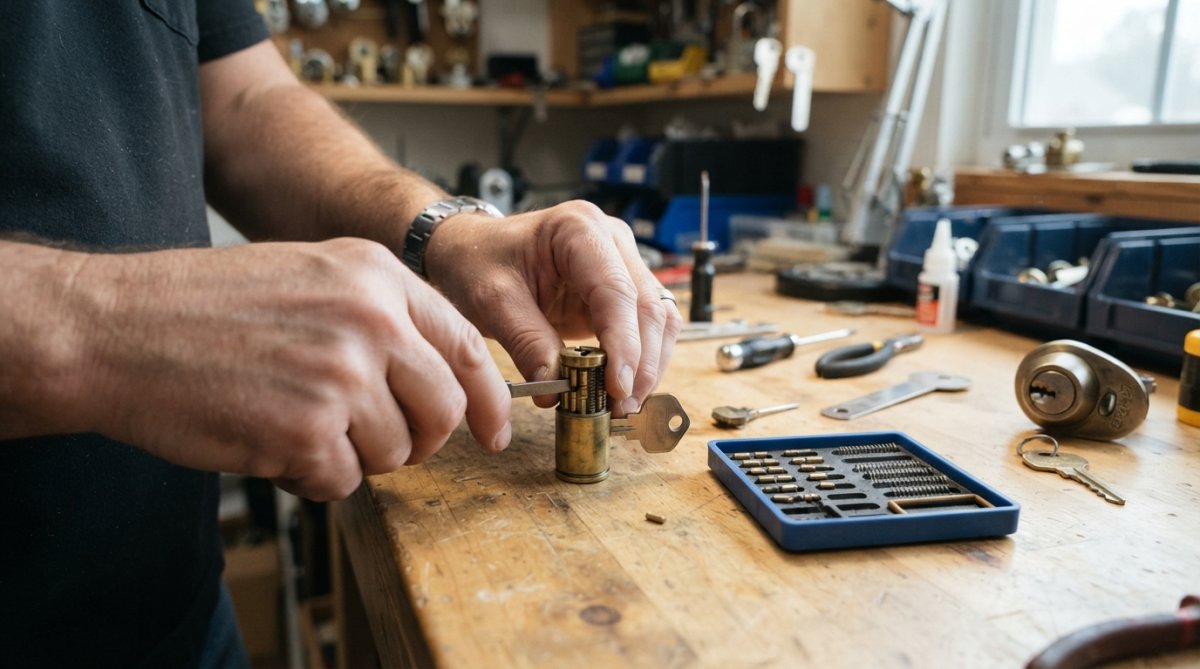
Rekeying a door lock cylinder rewards patience and careful organization. Before you begin, clear a workspace and lay out a magnetic tray to hold the pins and springs in order. You will need your rekeying kit, the new key, and a flat-head screwdriver.
Step 1: Remove the Lock Cylinder from the Door
Start by removing the screws on the interior mounting plate of the deadbolt or doorknob assembly. Pull the two halves of the lock apart, then disconnect the spindle and latch mechanism. With the interior hardware removed, slide the exterior cylinder out from the door. Set the screws aside in a labeled container so they do not get mixed up with the pins.
Step 2: Disassemble the Cylinder Housing
Insert your new key into the cylinder and turn it slightly to the locked position. Locate the retaining clip or cam at the rear of the plug and remove it with the plug removal tool. With the clip free, insert the follower tool into the cylinder housing to hold the driver pins and springs in place as you slide the plug out. Keep the follower tool pressed firmly against the plug to prevent springs from popping out.
Step 3: Replace the Tumbler Pins and Reassemble
Dump the old key pins from the plug into your tray. Referencing the bitting on your new key, select the correct key pins from your kit and drop them into each chamber of the plug. Slide the plug back into the housing while using the follower tool to transfer the driver pins and springs into place. Reinstall the retaining clip, test the new key, and then reattach the cylinder to your door.
How Long Does It Take to Rekey a Lock?
For a first-time DIYer, rekeying a single deadbolt typically takes 30 to 45 minutes once the lock is off the door (thisoldhouse.com). An experienced person can complete the pin swap in under 10 minutes per cylinder. The variable that slows most beginners is handling the tiny springs and pins without losing them.
If you are rekeying multiple locks, add roughly 10 minutes per additional cylinder after the first one. A house with three exterior doors might take about an hour of focused work, assuming you have the right kit and your locks are free of corrosion or damage.
Rekeying is a quick, cost-effective security measure. The primary time cost is your first attempt, so consider practicing on a spare interior door lock before working on your main entry points.
Brand Compatibility and Visual Troubleshooting
Lock manufacturers use different pin sizes, keyways, and cylinder dimensions, so brand compatibility is not optional. Here is the compatibility matrix most generic guides omit:
Brand-Specific Compatibility Matrix
| Brand | Keyway | Pin Diameter | Pin Sizes (Increments) | Kit Compatibility |
|---|---|---|---|---|
| Kwikset | KW1 (standard) / KW10 (smart key) | 0.115 inches | 0.018-0.045 inches (0.003 increments) | Kwikset-specific kits only |
| Schlage | SC1 (standard) / SC4 (restricted) | 0.115 inches | 0.018-0.045 inches (0.003 increments) | Schlage-specific kits only |
| Baldwin | Schlage-compatible (SC1) | 0.115 inches | Same as Schlage | Schlage kits work |
| Weiser | KW1 (many models) | 0.115 inches | Same as Kwikset | Kwikset kits work |
| Yale | Y1 (standard) | 0.115 inches | 0.018-0.045 inches (0.003 increments) | Yale-specific kits only |
Critical note: While Kwikset and Schlage share the same pin diameter, their keyways differ. A Schlage key will not insert into a Kwikset cylinder, and vice versa. Pin depths are also cut to different specifications, so you cannot swap pins between brands even if the diameter matches. Always verify the brand stamped on the plug or housing before purchasing a kit.
Visual Troubleshooting: What Went Wrong
When a lock does not reassemble smoothly, the problem is almost always one of four issues. Here is how to diagnose and fix each:
| Symptom | Likely Cause | Visual Check | Fix |
|---|---|---|---|
| Key will not insert fully | A key pin is seated too high in the chamber, or a spring is binding | Look into the plug chambers with a bright light. The pin should sit flush with the top of the chamber. | Remove the pin, verify it matches the bitting depth, and reseat it. |
| Key inserts but will not turn | The pin stack is too tall or too short for the shear line | Insert the key and look at the gap between the plug and housing. You should see a clean break line at the shear line. | Disassemble and re-measure each pin against the key bitting chart. |
| Plug will not slide out | The retaining clip or cam was not fully removed | Check the rear of the plug for a partially seated clip. | Use the plug removal tool to fully disengage the clip before applying pressure. |
| Springs ejected during assembly | The follower tool was not held firmly against the plug | Look for springs and driver pins scattered in the housing. | Retrieve all parts, re-lubricate the housing, and restart with the follower tool pressed firmly. |
The “Dropped Pin” Scenario
A common mistake is dropping a key pin and not knowing which chamber it came from. If this happens, do not guess. Disassemble the plug completely, dump all remaining pins into a tray, and start fresh, matching each pin to the bitting chart for your new key. Guessing will result in a lock that jams or fails to operate on the correct key.
If your lock uses security pins (spool or mushroom-shaped drivers), visual troubleshooting is more complex (peer-reviewed research). Security pins are designed to catch on the shear line during picking attempts, which means they can also catch during assembly if not perfectly aligned. If you are working with security pins and the lock binds, disassemble and restart rather than forcing the key.
When Brand Compatibility Fails
If your lock is an off-brand or older model with a non-standard keyway, a standard rekeying kit will not work. You have two options: replace the cylinder with a standard brand-compatible one (cost: $15-$40) or call a professional locksmith who can order the correct pins. Do not file down pins or modify a key blank, this will damage the cylinder and void any warranty.
When to Call a Professional Locksmith
DIY rekeying works well for standard deadbolts, but several situations call for professional help. If you have a high-security lock with security pins or an anti-pick keyway, a mistake during assembly can render the cylinder useless. The same applies if your hardware is rusty, seized, or uses an uncommon keyway your kit does not support.
Property managers coordinating multiple units often benefit from a master key system, which requires precise pinning calculations far beyond a simple rekey. Professional locksmiths have the expertise and key blank inventory to match your existing hardware. At Hallford Brothers Security Lock & Safe, LLC, we handle everything from single-cylinder rekeys to complex master key systems, with upfront pricing before any work begins.
Conclusion: Secure Your Home with Confidence
Rekeying your house locks is one of the most direct ways to regain control over your home’s security, whether you just moved in or want peace of mind. The process is approachable for a careful DIYer, but it demands the right tools, brand-matched pins, and patience. When your locks are worn, you need a master key system, or you prefer a guaranteed result, a professional service removes the guesswork.
Trust the experienced team at Hallford Brothers Security Lock & Safe, LLC to handle your rekeying and lock upgrades with the reliability that comes from 56 years in the industry. Our specialists provide expert resolution of lock issues with upfront pricing, so you know the cost before we start. Get a quote today and secure your home with confidence.
Frequently Asked Questions
Is it cheaper to rekey or change locks?
Rekeying is almost always the cheaper option when the existing hardware is in good condition. A rekeying kit costs far less than a full set of new locks, and if you do it yourself, you save on labor. Replacing locks makes sense only when the hardware is worn, damaged, or you want an upgrade, since new locks cost more per unit and require additional installation time.
Can you rekey a lock without replacing the lock?
Yes, that is the entire purpose of rekeying. The process involves removing the cylinder, swapping out the tumbler pins to match a new key, and reassembling the lock. The external hardware stays in place, so the lock looks and functions the same, but the old key will no longer work. This is a common practice after moving into a new home.
How long does it take to rekey a lock?
A single standard doorknob or deadbolt lock takes about 15 to 30 minutes for a first-timer using a rekeying kit. Once you have done a few, you can finish one in under 10 minutes. That time can increase if you encounter stripped screws, a stuck retaining clip, or an unfamiliar brand with a different cylinder design.
What tools are required to rekey a residential lock?
The best lock rekeying kit includes a follower tool, a plug depressor, and a set of new pins matched to your key bitting. You will also need a screwdriver to remove the lock from the door, needle-nose pliers for extracting old pins, and a small tray to keep springs and pins organized. Most kits are brand-specific, so verify compatibility before purchasing.
This guide provides general information on rekeying standard residential locks. For specific hardware or complex security needs, consult a licensed professional locksmith.